The Second Dutch attempt to capture Malacca (1608)

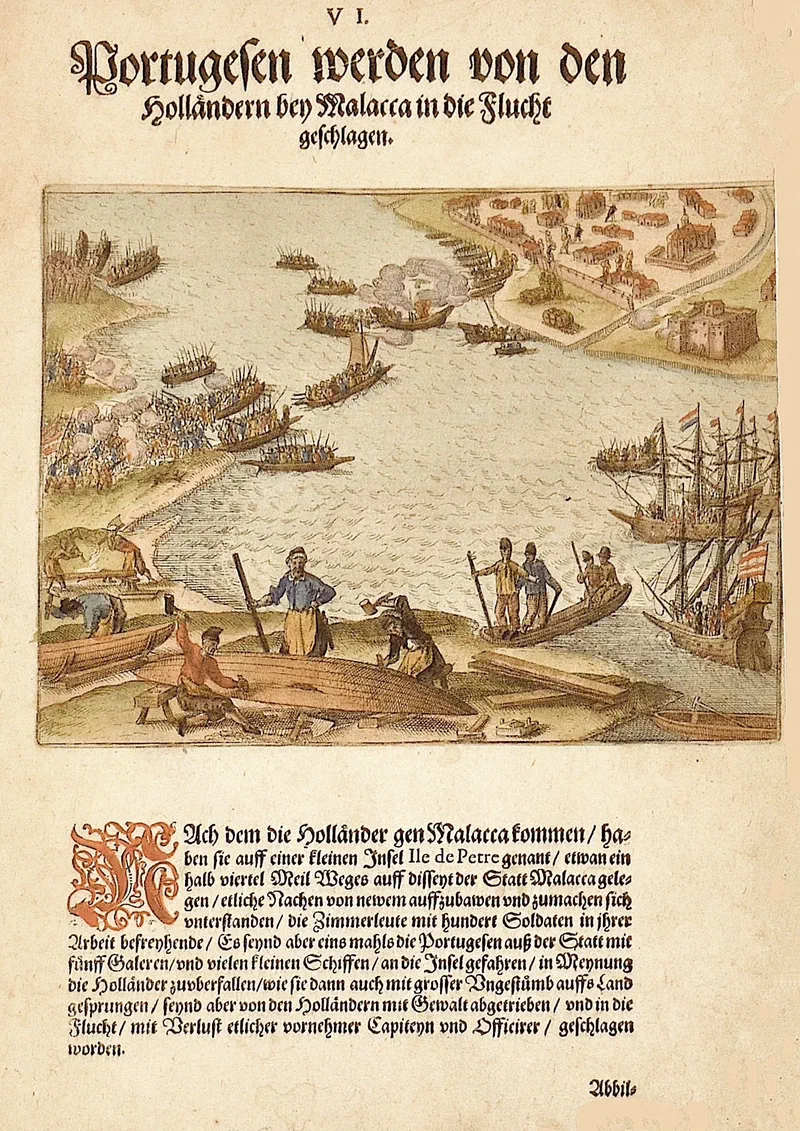
This engraving, published in 1612 by Johann Theodor de Bry, depicts Dutch forces constructing boats on a small island - Pulau Upeh - off Malacca’s coast in late 1608. Though the illustration portrays an inaccurate plan of Malacca seen in the distance, it remains a rare visual depiction of Dutch military operations decades before their eventual conquest.
History textbooks tell us that the Dutch captured Malacca in 1641, but hardly mention the earlier Dutch attempts to prise this prized port from the clutches of the Portuguese. As early as 1606, the Dutch had “made a compact with Johor to seize Malacca,” though this first attempt failed.
In 1608, the Dutch sent their East India Company fleet under Admiral Pieter Willemsz Verhoeff - comprising “nine large and four small ships” - for another attempt.
Writing in 1884, based on Dutch primary sources, the historian Pieter Anton Tiele, who was also librarian of Utrecht University, tells us:
“On 23 November 1608, Verhoeff arrived off the coast of Malacca. The Portuguese, having received timely warning of his approach, had already moved their ships out to open sea. Only an old, abandoned carrack remained in the harbour, which they set on fire themselves.”
Onboard the invasion fleet was a German named Johann Verken, “a native of Leipzig from Meissen”, who had joined the Dutch East India Company - the VOC - as a “soldier and corporal” earlier in November 1607. After all his adventures serving the Company, Verken made it back to Amsterdam in 1612 and published the journals he kept.
This engraving was part of a monumentally ambitious work by publisher De Bry called “Indiae Orientalis (East Indies).” Comprising 13 parts, this compendium contained “accounts of voyages made by European explorers to the East Indies.” The first eight parts were published in German (1597-1606) by Theodor de Bry’s sons - Johann Theodor and Johann Israel. Johann Theodor alone issued parts 9-11, while the final parts (12-13) were published by Matthaeus Merian.
The renowned engravings elevated these publications to what is now considered a quintessential early modern “coffee-table” book—crafted for a general audience rather than those directly involved in trade or colonial affairs.
The page shown here is from Part IX - a particularly interesting part of the series as it contains original and contemporary material from the time - De Bry actually uses an excerpt from Verken’s journals to accompany this engraving, providing us with a firsthand account of the 1608 attempted capture of Malacca by the Dutch. Below is Verken’s description of a Portuguese surprise attack against the Dutch:
“The Portugals are put to flight by the Hollanders at Malacca.
When the Hollanders came unto Malacca, they undertook upon a small Island called ‘Ile de Petre’, lying about half a quarter of a mile on this side of the city of Malacca, to make several new Boats, defending the Carpenters [Shipwrights] in their work with a hundred Soldiers. But upon a time the Portugals came forth from the City with five Galleys and small Ships unto the Island, purposing to fall upon the Hollanders unawares, and did indeed leap ashore with great fury, but were by the Hollanders driven back by force, and put to flight, losing several distinguished Captains and Officers.”
According to Serge Jardin, the “Ile de Petre” mentioned by Verken refers to “Ilha de Pedra (Stone Island), located in front of Klebang, used as laterite stone quarry by the Portuguese” - today’s Pulau Upeh.
Sources:
- Pieter Anton Tiele (1884), “De Europeërs in den Maleischen Archipel. Zevende Gedeelte: 1606–1610 (The Europeans in the Malay Archipelago, Part Seven: 1606–1610)
Bron: Bijdragen tot de Taal-, Land- en Volkenkunde van Nederlandsch-Indië, 1884,
32ste Deel, 1ste Aflevering [4e Volgreeks, 8e Deel], pp. 49–118. - Ingrid S. Mitrasing (2014), “Negotiating a New Order in the Straits of Malacca (1500–1700)”, Published in “KEMANUSIAAN Vol. 21, No. 2, (2014), 55–77”
- Isabella Matauschek (2015), “Exotic Knowledge as Commodity: De Bry’s Historia Indiae Orientalis”, Published in Specialist Markets in the Early Modern Book World, Volume 40
- “India Orientalis”, Yale Center for British Art, https://collections.britishart.yale.edu/catalog/orbis:9597268
- Jerald T. Milanich (2016), “Theodore de Bry, Richard Hakluyt, and the Business of Books: De Bry’s 1591 Engravings of Florida Timucua Indians”
Sources translated from Dutch and German.