The Roar of Krakatoa Across the Straits of Malacca (1883)

Sunday, 26 – Monday, 27 August
On a Monday morning in August 1883 – exactly 142 years ago to the day – residents of Penang in the Straits Settlements, at the northern entrance of the Straits of Malacca, thought they heard “a salute from an American corvette” in port. Such sounds were common and usually passed without a second thought. This time, however, they were mistaken: the ship had left four hours earlier.
A correspondent at Selangor, whose account was later published in the Straits Times, said he heard the same sounds, described as “like the firing of a man of war at general quarters 3 or 4 miles off. The peculiarity of the concussions was, in a place like this far from the Coast, the sound as of the separate discharges of single heavy guns without rumbling nor echo”.
He reported that those who heard the explosions agreed the “loudest and the last explosions heard were at 10.30 a.m. to 11.00 a.m.” Yet the mysterious sounds of phantom guns had already been heard the day before in Selangor, at “about 4.30 p.m, on Sunday the 26th”. People in Perak too heard “sounds were thought to be distant salvos of artillery” both that day and the day before.
Farther south in Singapore, the capital of the Straits Settlements, residents also heard “mysterious and unaccountable detonations … continuously during all last night [26th] all this forenoon [27th]”. The harbour master even sent “a steam launch out westward, which returned with a report that it believed it to be a volcano out burst”.
Later that day, a message arrived from “Mr. W. Grigor Taylor, General Manager of the Telegraph Company” at Batavia – today’s Jakarta – reporting:
“During night terrific detonations from Krakatau … audible as far as Soerakarta, – ashes falling … Batavia now almost quite dark – gas lights extinguished during the night … Shops, offices close, business at a standstill”.
Even then, the press dismissed any connection between the reports, commenting that “it is beyond belief” that “Krakatau … situated 420 nautical miles distant from Singapore” could be heard at such a distance.
Tuesday, 28 August
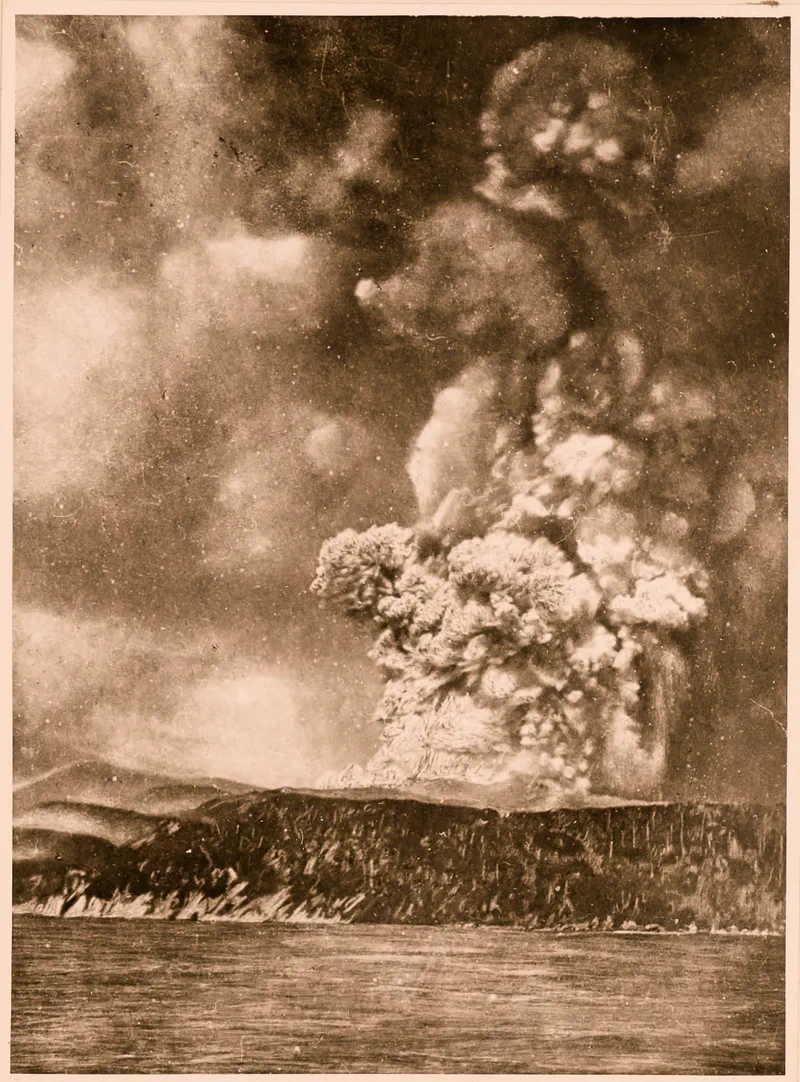
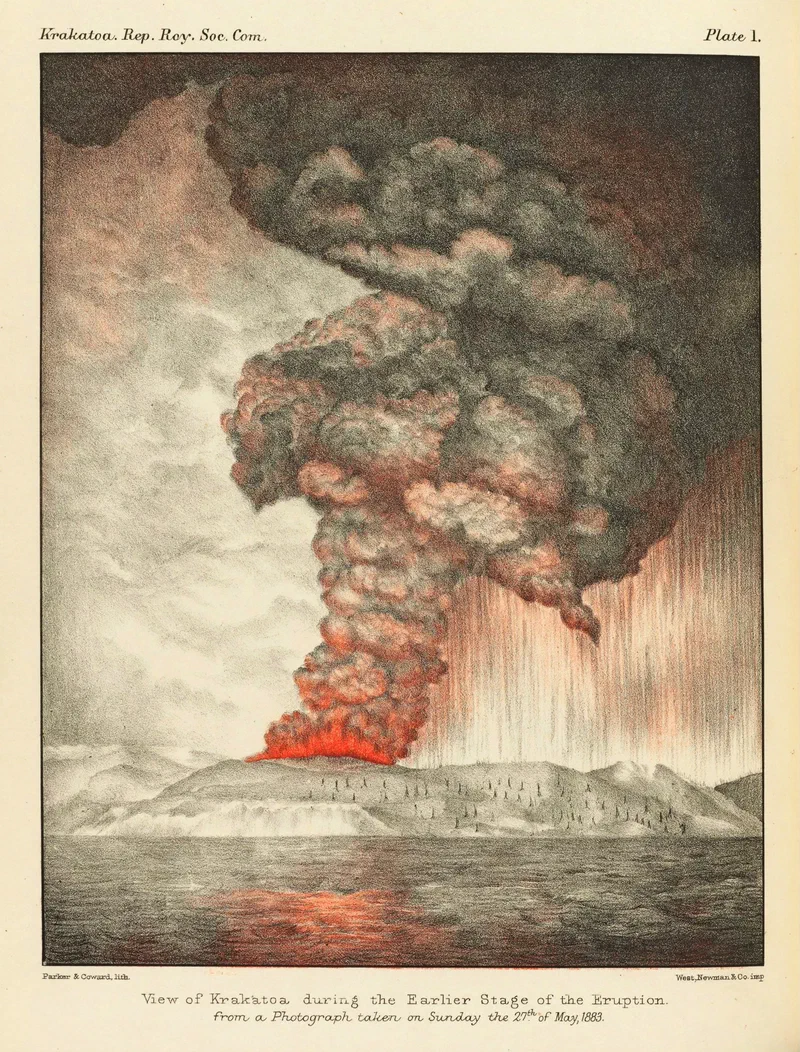
The following day, “Captain Olivari, of the Italian barque Carmelina” came into port at Singapore bearing news that as they were passing the Straits of Sunda earlier on 15th July – the narrow passage between the islands of Sumatra and Java – they had witnessed the “active eruption” of a volcano there from a distance of “5 or 6 miles”, which came “very nearly setting fire to the sails” and covered his vessel with “a quantity of lava”. Krakatoa had begun its relentless eruptive phase on 19 June 1883, a prelude to the cataclysm that has now come to pass.
Wednesday, 29 August
The Straits Settlements Government then received a stark telegram from the Netherlands Indies Government:
“Strong volcanic eruptions in Sunda Straits, Charts not be trusted at all, Lights destroyed”.
Allan Macclean Skinner, the Colonial Treasurer and founding member of the Straits branch of the Royal Asiatic Society, wrote to the Straits Times, insisting it was entirely possible the sounds were indeed from Krakatoa.
Thursday, 30 August
On Thursday morning at 7.00 a.m., another update arrived from Batavia:
“The whole district known as the Residency of Bantam is an ashy desert. Cattle foodless. Famine imminent. Population starving and in despair.”
Saturday, 1 September
By then, the Malayan public was beginning to grasp the scale of the disaster. “I looked for the arrival of the Straits Times yesterday (Friday) with much curiosity, to see if therein I could find any explanation of the sounds heard here last Sunday and Monday”, the correspondent at Selangor recounted.
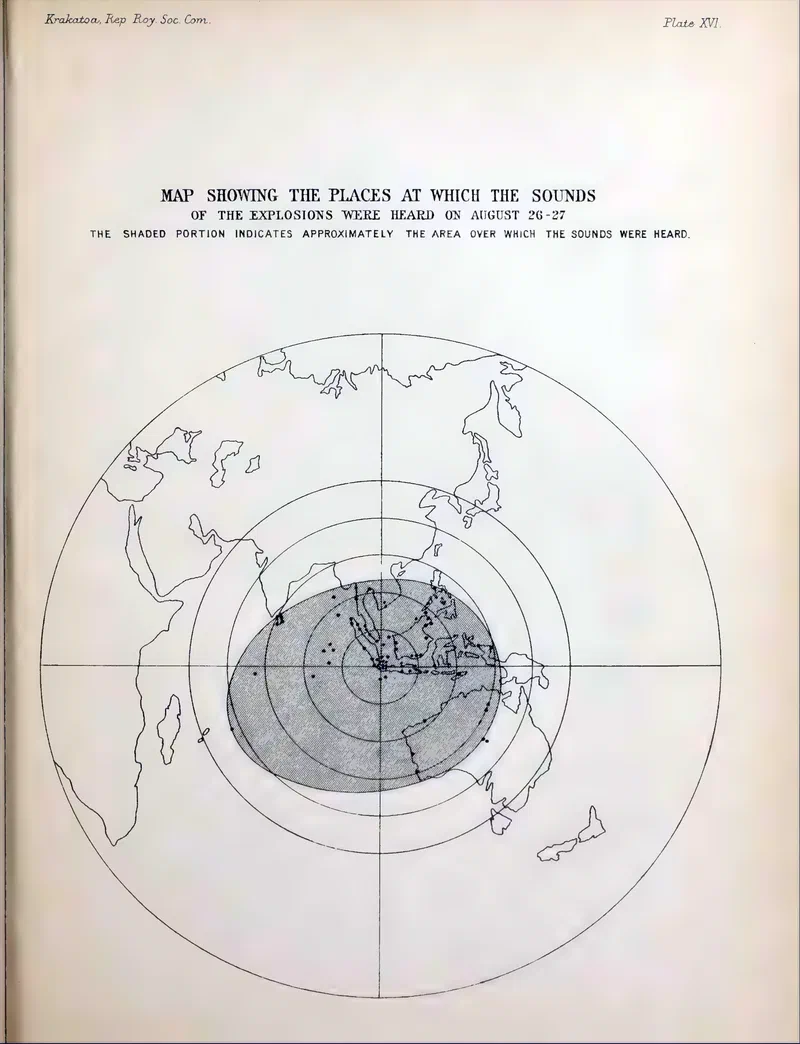
The sounds along the west coast of the Malay Peninsula, from Singapore to Penang, were indeed from the eruption of Krakatoa, as Skinner had postulated. The eruption was an event of global proportions. The explosion was heard as far as Perth, Australia, and nearly 5,000 km away across the Indian Ocean at Mauritius. So powerful was the blast that “the acoustic pressure wave circled the globe more than three times”.
The following day, the Governor of the Straits Settlements received a grim telegram from the Governor General of the Netherlands Indies, hinting at the disaster’s human cost:
“Thanks for your kind offer; if necessary I will not fail to apply to you … extent of calamity yet unknown; in one single district ten thousand people were drowned. A whole province became a desert.”
The official figures by the Dutch later put the death toll at 36,417.
Crimson Skies
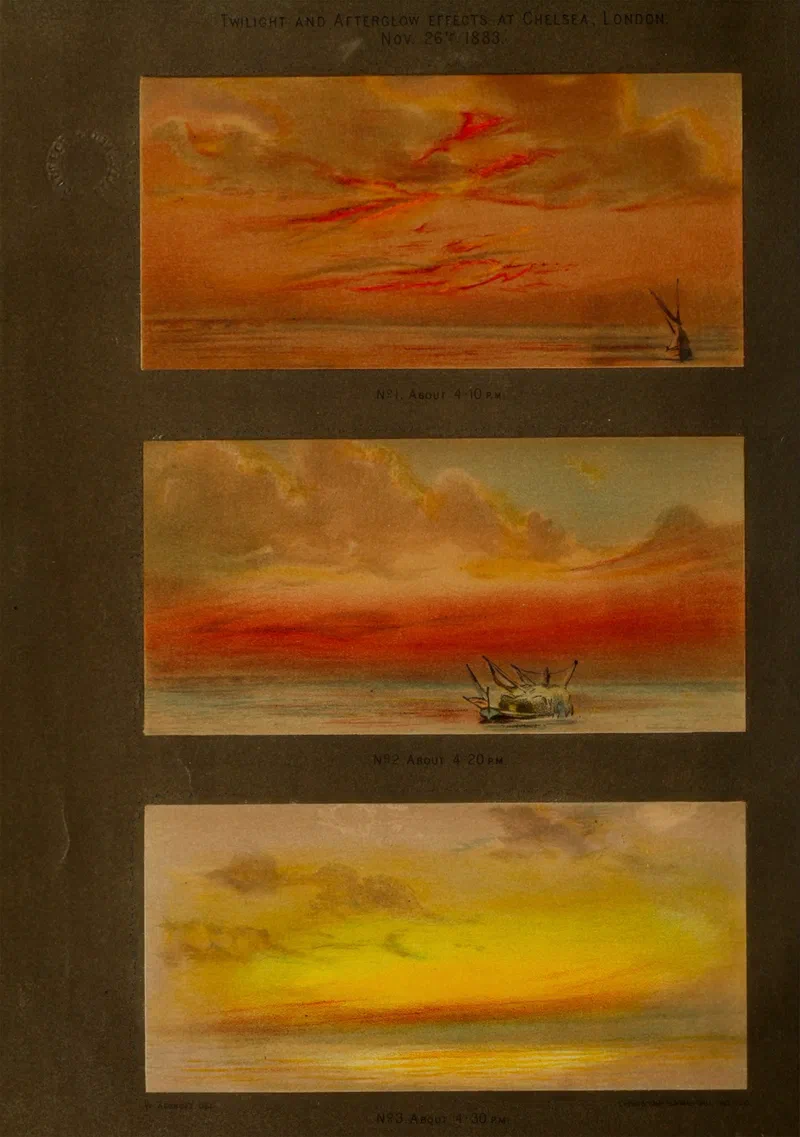
The Irish astronomer, Sir Robert Stawell Ball, who wrote much about Krakatoa, explained in his 1892 book, “The dust of Krakatoa had put a girdle round earth in thirteen days!” This “vast volume of dust in the air” caused a “wonderful series of optical phenomena” observed throughout the world after the eruption – spectacular sunsets. Ball, impressed by the speed with which the volcanic dust had reached every part of the planet, concluded the chapter with the remark, “How small the world is after all!”.
These Krakatoa sunsets, as they came to be known, were also observed in Malaya. One Penang resident who witnessed the phenomenon still recalled it vividly 19 years later, writing in the Pinang Gazette:
“Everybody must remember the remarkably vivid sunsets which accompanied … the Krakatoa Explosion in … 1883 … characterised not only by the brilliance but also by that indescribable weird eeriness which was the distinguishing feature of the Krakatoa sunsets”.
For some of us today, such descriptions may not be entirely unfamiliar. The eruption of Mount Pinatubo in the Philippines in 1991 also produced spectacular sunsets across Southeast Asia – can you remember them?
Sources :
- Straits Times (1883), “The Volcanic Outburst in Sunda Straits”, 6 October 1883, p. 3
- Straits Times Weekly Issue (1883), “How Krakatoa was Heard in Selangor”, 13 September 1883, p. 6
- Straits Times (1883), 27–31 August 1883
- Straits Times (1883), 1 September 1883
- Rogier Diederik Marius Verbeek (1886), Krakatau, pp. 533–538
- Straits Intelligence M09 1883, 1 September 1883, p. 2
- George James Symons (1888) (ed.), The Eruption of Krakatoa and Subsequent Phenomena, Report of the Krakatoa Committee of the Royal Society
- Robert Stawell Ball (1892), “In Starry Realms”, pg. 319–342
- De uitbarsting van de Krakatau, http://hdl.handle.net/1887.1/item:788817 , KITLV 5888, Leiden University Libraries Digital Collections (Photo)