The Chinese cemetery at Batu Lanchang and the origin of its name

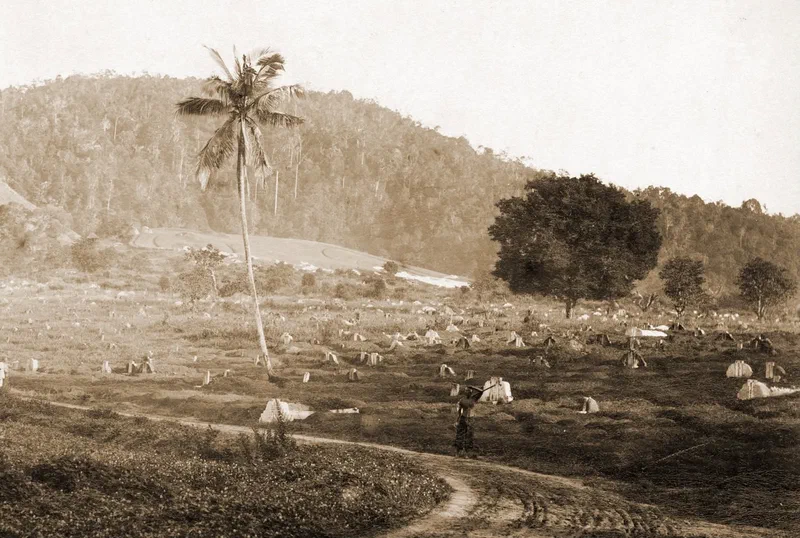
View of the Chinese cemetery at Batu Lanchang at the turn of the 20th century (before 1908) by the German photographer Ernst August Kaulfuss. In 1899, it was reported the burial ground was already “over-crowded with tombs” and declared by “many Chinese geomancers to the best Fengshui in Penang”. According to a contemporary account, at “the head of the private road to the burial-ground [was] a sign-post to ‘Koh Chye hill’, adjoining Batu Lanchang burial-ground” - the private cemetery of the Koh family, where the patriarch Koh Lay Huan or Che Wan was buried in 1826. Che Wan arrived just days after Captain Light landed at Tanjong Penaga (now George Town) and requested from him permission to settle in Penang.
Origins of the name Batu Lanchang
The 1846 edition of the “Simmonds Colonial Magazine and Foreign Miscellany, Volume 8”, explains that “Batoo Lanchang [Batu Lancang], derives its name from a large rock on the sea-beach, near to the village of the same name … which is held in much reverence by the Malays as a Tampat Crammat [Tempat Keramat], or Holy Spot”.
“When attacked by severe sickness or by other worldly calamities, [they] would make solemn and religious promises” at the keramat seeking assistance. If the outcome is favourable, the person making the vow would prepare a kenduri to thank the spirit.
At this thanksgiving ceremony, offerings are made, placed on a symbolic boat called a lanchang, “sometimes, made of wood, but more frequently, of leaves and plantain stalks … rigged with a leaf for a sail and then sent off to sea”; symbolising the payment of a vow fulfilled - “Sudah bayar nyat [sudah bayar niat]”. The offerings are often the flesh of both white fowl and black fowl, cooked and half-cooked pulut (glutinous rice) and bertih (rice pops).
The actual boat called lanchang or lancharan is a “Malay war-vessel; a ship built for speed and fighting”. The English and Portuguese nautical terms, launch and lanchão respectively, meaning “the largest boat carried on an armed sailing ship”, are derived from lanchang.
Source:
- Peter Lund Simmonds, William Henry Giles Kingston (1846), “Simmonds Colonial Magazine and Foreign Miscellany” Vol.8 pg 57-58.
- Walter William Skeat (1900), “Malay Magic: Being An Introduction To The Folklore And Popular Religion Of The Malay Peninsula”, pg. 433-435
- MBRAS (1885), “Notes and Queries - Issues 1-4”, pg. 65
- Yeow Sew Beow (1899), “Street Nomenclature”, Pinang Gazette and Straits Chronicle, 22 April 1899, pg. 4
- Photographs with town views, landscapes and people of Penang, Perak, Siam, Singapore and Atjeh Or. 27.424 (Photo)