The Blomefield cannon at Fort Cornwallis

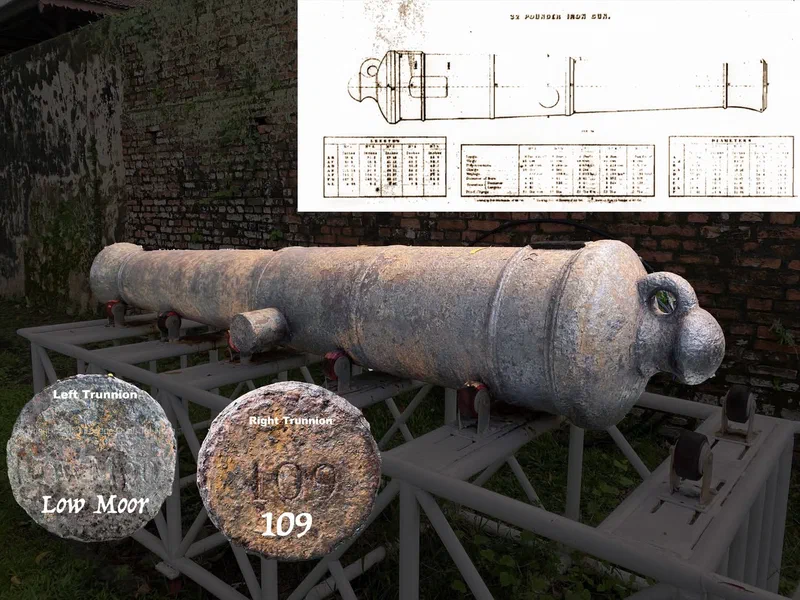
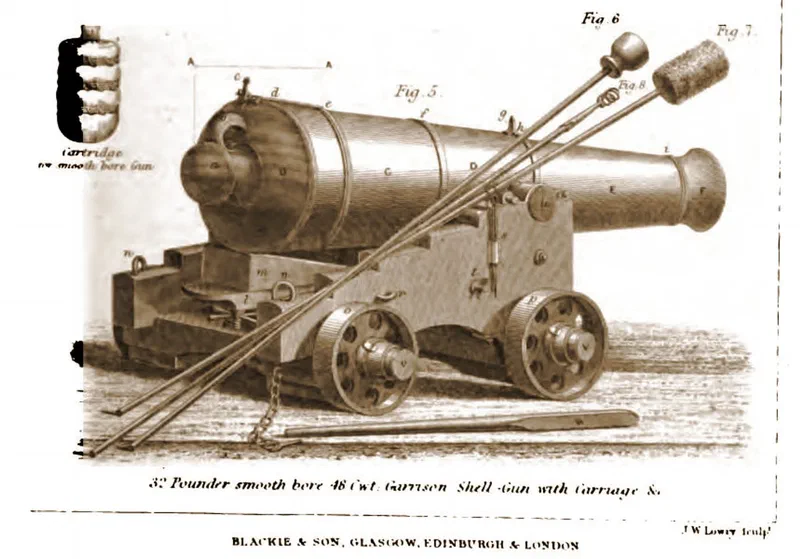
When I was at Fort Cornwallis this morning, I noticed there was a collection of cannons unearthed between 2019 and 2020 during the excavation of the moat. These cannons, now displayed near the main entrance, had previously undergone a process of restoration by archaeologists at USM before being returned to the fort. Regrettably, no information was provided for these displayed cannons, some showing significant signs of corrosion. I recognised one of the cannons as a Blomefield due to its distinctive loop on the breech. Its shape bore a striking resemblance to the cannon at the Wellesley school and the other 32-pounders incorrectly mounted on the parapets since WW2. Despite its topside markings being illegible, luckily the marking on the left and right trunnions - the supporting cylindrical projection on each side of the cannon - could still be read. The left trunnion bears the inscription, almost illegible, “Low Moor,” indicating the foundry, while the right trunnion displays clearly “109,” the manufacturer’s serial number – the 109th unit of the batch that was cast using the same pattern.
The Low Moor Ironworks, established near Bradford in 1791, commenced the casting of Blomefield pattern cannons a year later, in 1792. This suggests that the creation of the cannon occurred after this date. In March 1810, the Penang Presidency government informed the Directors of the East India Company that “a detailed Fascine Battery has recently been commenced upon, situated on the Beach of the Esplanade” and that it was “intended to mount not less than Seven heavy Guns 32 Pounders”. Years earlier, at the start of the Presidency, in November 1805, Colonel Norman Macalister reported the presence of eight heavy guns at the “half moon Battery” east of the Government House. It is plausible that these guns may have been reused at the new Fascine Battery constructed in 1810. The 32-pounder at Wellesley school and similar ones on the parapets were manufactured within a year of each other, 1797-1798.
This newly found cannon, having the profile of a typical Blomefield 32-pounder, is likely one of the eight heavy guns mentioned by Macalister, forged during the same period as the other cannons mentioned earlier.
Sources:
David McConnell (1988) “British Smooth-Bore Artillery”, pg. 61-62
Straits Settlements Factory Records, Vol. 26, Council Proceedings, 15 March 1810, pg. 403-406
Straits Settlements Factory Records, B1, 19 November 1805, pg. 60-65
Marcus Langdon, “Penang the Fourth Presidency of India, 1805-1830, Volume 1, Book 1 - Fort Cornwallis”, pg. 59, 83
London Society, Volume 36, “The Low Moor Company”, pg. 347