Mr. Jones and Twelve Hundred Steps Temple at Paya Terubong (1881)

High in the hills above Paya Terubong sits a temple with a breathtaking view of the Penang Strait and the mainland beyond. Officially, it’s Cheng Kon Sze (清觀寺) – the Abbey of Clear Contemplation. It is better known by its Hokkien moniker, Chheng-jī-chàn (千二層), meaning twelve hundred steps, alluding to the long flight of granite steps that leads up to it. The Malays know it as Tokong Bertapa – the hermitage temple.
According to Yeow Sew Beow, as part of his extensive research on Penang place names published in 1899, the idea for building the “Chinese vegetarian temple” was conceived by the Penang photographer William Jones who, “through subscriptions raised from the Chinese community”, built the temple “on the summit of the Paya Trubong hill, above the plantation of the Gan Ngoh Bee family, called ‘Friedland’”.
Interestingly, Yeow also mentions that “ceremonies are held here every year from the 1st to the 9th moon” with “Mr Jones acting as master of ceremonies”; a most bizarre scene that can only happen in Penang. But there is another twist, while there was indeed a European photographer named William Jones who started his business in Singapore in 1865 and then moved to Penang, the business was later sold to Wong Yin Poh, who was nicknamed “Mr Jones”. Was Yeow referring to the real Mr William Jones or Cantonese Mr Jones? Given the meticulous nature of Yeow’s writings, it seems out of character for him to refer to Wong’s nickname; an intriguing mystery.
The signboard on the archway at the entrance reads 朝元洞 (Cháoyuán Dòng), the Grotto of Homage to the Primordial. The phrase 朝元 is an old Daoist one, best known from the 朝元圖 (Chaoyuan tu), the great fresco of 1325 in the Hall of the Three Pure Ones (三清殿) at Yongle Gong 永樂宮, the Palace of Eternal Joy, at Shanxi. That mural shows 286 members of the Taoist pantheon assembled in audience before the Three Pure Ones — the Jade Pure One, the Supreme Pure One and the Grand Pure One. The name was probably chosen for the Paya Terubong archway based on the same idea, a procession of devotees making their way up the steps to pay respect to the deities.
Katharine Sim, who drew the temple in 1949, wrote, “The first pavilion is dedicated to the Nine Emperor Gods, who are worshipped in Penang on the Double Ninth. On that day, or the Sunday preceding it, hundreds of people fill the little lane that leads from Ayer Hitam village, and make the pilgrimage on foot and up the steps to burn their joss before the Emperor Gods”.
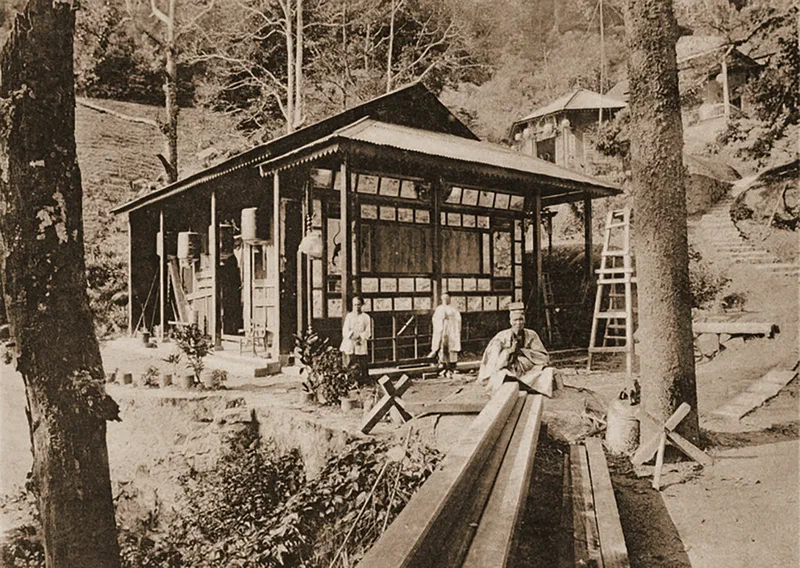
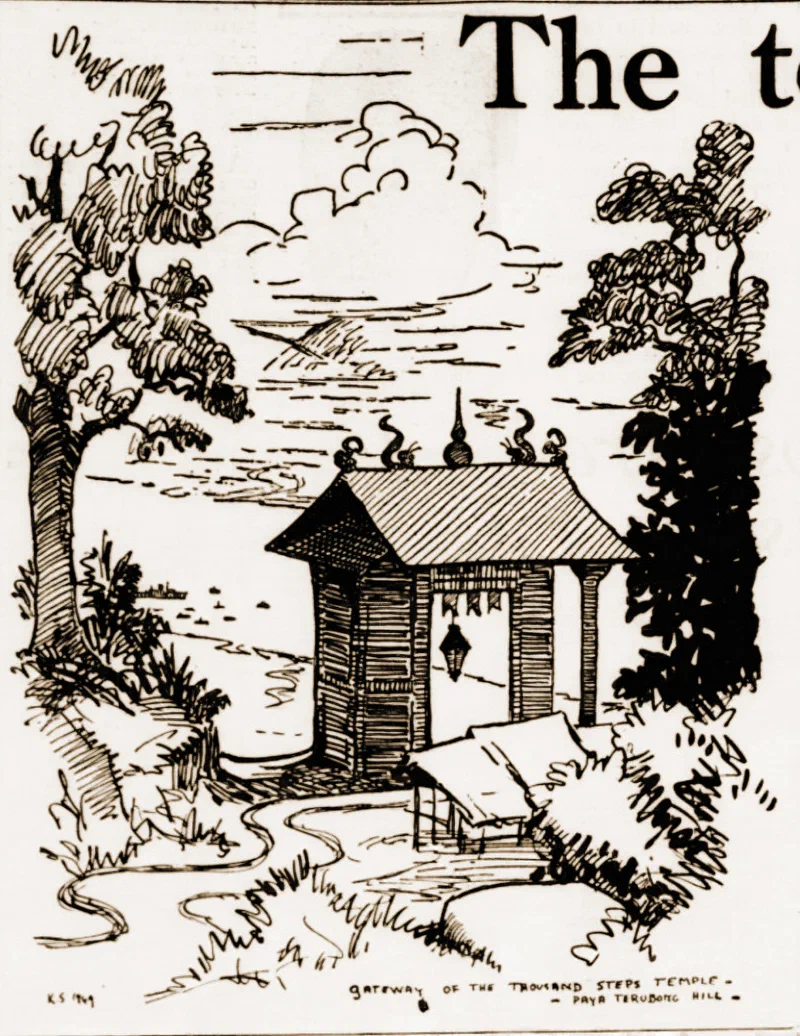
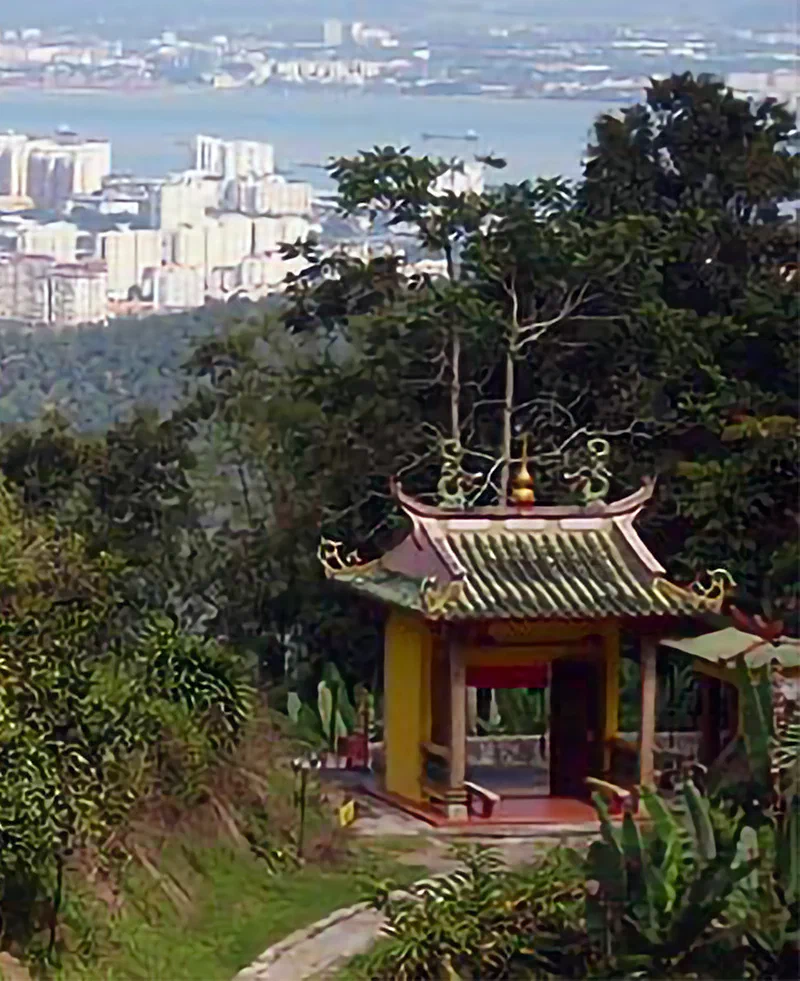
Images: the earliest, from a Pritchard & Co. postcard of the first decades of the 20th century, shows a few Daoist priests on the lower terrace with the main buildings behind – now in the Charles Wheeler Collection, University of Bristol; perhaps taken by Mr Jones himself. The drawing is Katharine Sim’s, 1949. The colour photograph is a detail from a shot by Rob Dickinson taken about a decade ago.
Sources:
- Katharine Sim, “The Temple of the 1,200 Steps,” The Singapore Free Press, 17 December 1949, p. 1.
“Yongle gong,” in The Routledge Encyclopedia of Taoism, ed. Fabrizio Pregadio, vol. 2, M–Z (London: Routledge, 2011). - Angkongkeng.com, “槟城千二层清观寺 Penang Thousand Stairs Temple Qing Guan Si,” https://www.angkongkeng.com/malaysia/20-penang/546-thousand-stairs-temple-qing-guan-si
- Charles Wheeler Collection, “Cheng Kon Sze Temple (清觀寺), Paya Terubong, Penang, Malaysia,” Historical Photographs of China, University of Bristol, ref. Wr-s140.
- Yeow Sew Beow, “Street Nomenclature”, Pinang Gazette And Straits Chronicle, 22 April 1899, pg. 4
- National Library of Singapore, Koh Seang Tat (1833–1910) and his wife. Accessed: https://www.roots.gov.sg/Collection-Landing/listing/1325227