Description of Malacca in Waldseemüller’s Carta Marina (1516)

In 1507, the German cartographer Martin Waldseemüller published his Universalis Cosmographia — “A map of the whole world according to the tradition of Ptolemy and the explorations of Amerigo Vespucci and others”. This was the map that famously named the new continent “America” after Vespucci’s forename.
Like the 1502 Cantino planisphere before it, Waldseemüller’s map still followed Ptolemy’s ancient and highly distorted depiction of the Malay Peninsula, known since antiquity by Europeans as the Golden Chersonese – chersonesus being the Greek word for peninsula.
It was this same Golden Chersonese that Columbus believed he had found when he reached Cuba in October 1492. Beyond it, he thought, lay India. The realisation that he had instead stumbled upon an entirely unknown continent would come later, through Vespucci’s deductions.
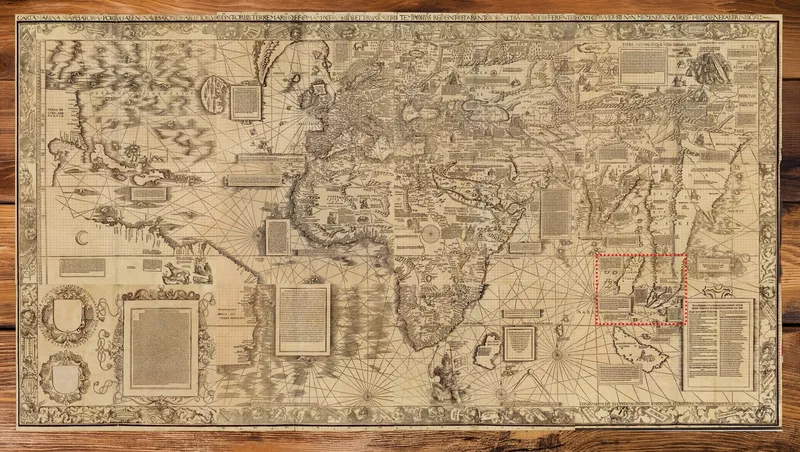
A decade after his first map, Waldseemüller broke decisively from Ptolemy. His 1516 Carta Marina drew not on ancient authority but on contemporary sea charts and the accounts of recent explorers. As he wrote in the map’s introduction:
“…just as in the first [map] the image of the whole world agreed with that of the ancient authors, so in this one, the new and present face of the world may shine forth … I have followed the most approved nautical charts … and made ample use of recent authors’ travel narratives, regional maps, and the accounts of some recent explorers …”
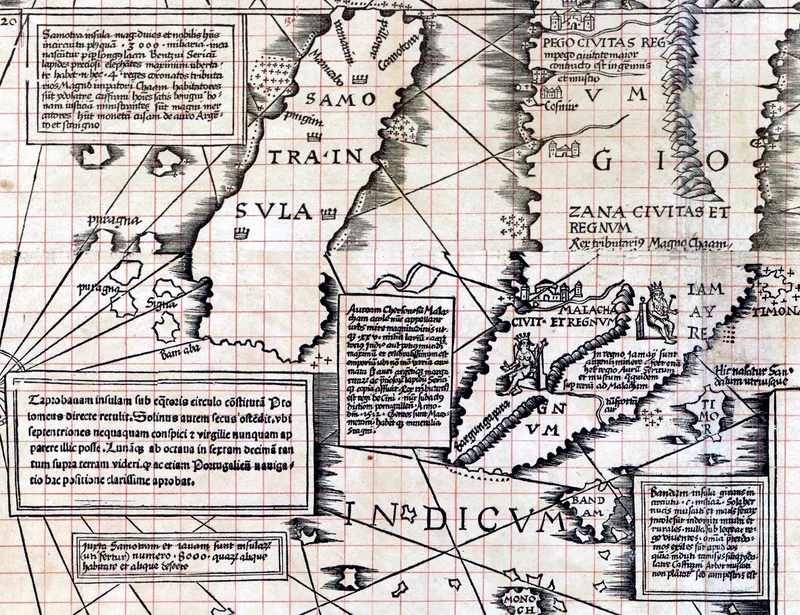
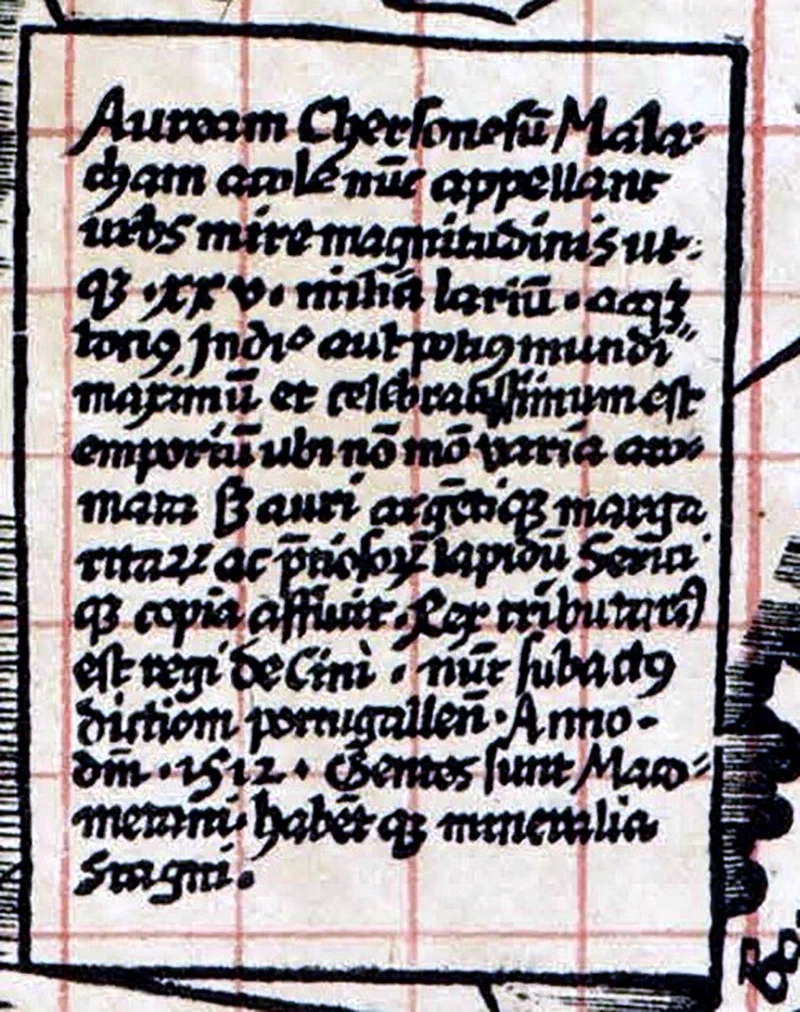
Malacca appears on the Carta Marina, just five years after its capture by the Portuguese in 1511, with the following text, in highly abbreviated Latin:
Auream Chersonesū Malacham acole nūc appellant urbs mire magnitudinis ut q · XXV · milia lariū acq[ui] to[cius] Indio aut potius mundi maximū et celebratissimum est emporiū ubi nō mō varia aromata s[ed] auri argentique margaritarum ac pretiosorum lapidum sericique copia affluit. Rex tributari[us] est regi de Cini, nū subact[us] dictioni portugallen[sium], Anno d[o]m[ini] · 1512 · Gentes sunt Macometani, habent q[ue] mineralia Stagni.
The Golden Chersonese, which the Inhabitants doe now call Malacca, is a Citie of marveilous Greatnesse, having twentie five thousand Hearths [households]†, and is the greatest and most renowned Emporium of all the Indies, or rather of the whole World, whereunto floweth not onely sundrie Spices, but also great Store of Gold, Silver, Pearles, precious Stones, and Silke. The King is Tributarie unto the King of China, and is now brought under the Dominion of the Portingalls, in the Yeare of our Lord 1512‡. The People are Mahometans [Muslims], and they have Mines of Tinne.
Semenanjung Emas yang kini dipanggil penduduknya Melaka, adalah sebuah kota yang amat besar, mempunyai dua puluh lima ribu isi rumah tangga, dan merupakan pusat perdagangan yang terbesar serta termasyhur di seluruh Hindia, malah di seluruh dunia. Ke sini mengalir bukan sahaja pelbagai rempah ratus, tetapi juga emas, perak, mutiara, batu permata, dan sutera yang berlimpah ruah. Rajanya memberi penghormatan kepada Raja China, dan kini telah ditakluki oleh orang Portugis, pada tahun Masihi 1512.‡ Penduduknya beragama Islam, dan mereka mempunyai lombong bijih timah.
† Lariū (Larium): Derived from lares (the Roman gods of the hearth). Early modern writers translated hearths directly into “housholdes” to denote population sizes.
‡ The date 1512 is an error. Waldseemüller’s description draws mainly from a letter sent by King Manuel I of Portugal to Pope Leo X in June 1513, announcing that his general Afonso de Albuquerque had conquered Malacca in 1511. The latter part of the description — concerning the city’s trade, its tribute to the King of China, and its tin mines — derives from the account of Ludovico di Varthema, an Italian traveller who visited Malacca around 1505.
Sources:
- Amerigo Vespucci (1504). “Lettera di Amerigo Vespucci delle isole nuovamente trovate in quattro suoi viaggi (1504)”
- Tennant J.S. (2021), “Columbus and the Idea of Cuba”, British Library - Americas and Oceania Collections blog
- Jim Siebold (1994), “#306 Cantino World Map”, Published in “Renaissance Maps: 1490-1800”. Monograph.
- James Johnstone (1926), “A Study of the Oceans”, pg. 82-83
- Jean Denucé (1908), “Les Origines de la Cartographie Portugaise et Les Cartes des Reinel”
- Chet Van Duzer (2020), “Martin Waldseemüller’s ‘Carta marina’ of 1516”