Amerigo Vespucci’s mention of Malacca (1504)

On Sunday, 28th October 1492, the Genoese explorer and navigator, Cristoforo Colombo - better known as Christopher Columbus - landed on the island of Cuba and claimed it for the King of Spain. Columbus believed “he had found the promontory called the Aureus Chersonesus” or the fabled Golden Chersonese - meaning Golden Peninsula; the name given to the Malay Peninsula by the ancient geographer Ptolemy. Beyond was his final destination - India; or so he thought. Columbus “himself did not realise he had found a new continent”.
This geographical misconception would later be corrected by another Italian, the Florentine navigator Amerigo Vespucci, who realised that they had found a continent previously unknown to the Europeans.
The German cartographer Martin Waldseemüller, after reading a published letter detailing the voyages of Amerigo Vespucci - known as the “Letter to Piero Soderini, gonfaloniere (1504)”, thought that, “I see no reason why anyone could properly disapprove of a name derived from that of Amerigo, the discoverer, a man of sagacious genius. A suitable form would be Amerige, meaning Land of Amerigo, or America…”. In April 1507, he published a map, Universalis Cosmographia, and named the new continent - America. This groundbreaking map was based on an earlier 1502 map, dubbed the Cantino planisphere after Alberto Cantino, an agent for the Duke of Ferrara, who successfully smuggled it from Portugal to Italy. “While yet in Lisbon, the probability is that Cantino interviewed [Amerigo] Vespucci, who had just returned to that city from his third voyage, and obtained from him supplementary information, which we assume to be the additional names in a cursive handwriting”.
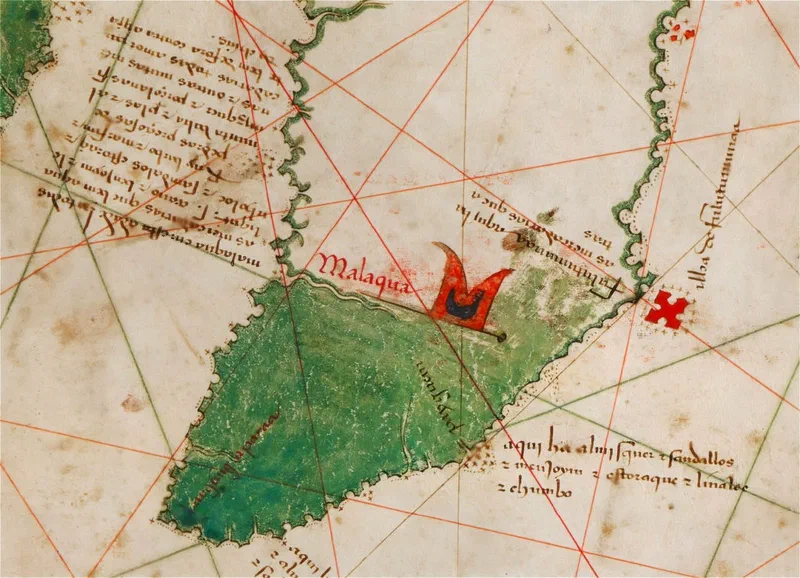
The “Cantino planisphere” shows Malaqua (Malacca) and the accompanying notes, written upside down, read as follows:
“Malaqua - in this city there is all the merchandise that comes to Calicut*, cloves and benzoin and lignaloes and sandalwood, storax and rhubarb and ivory and precious stones of great value and pearls and musk and fine porcelain; most of it comes from outside, on the side of the land of the Chinese”.
Amerigo Vespucci, writing about his fourth voyage in 1504, mentions Malacca by name and also Calicut as in the above note:
“We departed from this port of Lisbon, six consort ships, intending to go in quest of an island toward the east, called Melaccha, of which we have information that it is very rich and that it is, as it were, the emporium of all the ships that come from the Gangetic Sea and the Indian Sea, just as Cadiz is the port of call of all vessels passing from east to west and from west to east, [as this Most Serene King is informed,] on the route to Calicut…”
He never made it to Malacca.
* Calicut, a coastal city in the south Indian state of Kerala, is now known as Kozhikode.
Sources:
- Amerigo Vespucci (1504). “Lettera di Amerigo Vespucci delle isole nuovamente trovate in quattro suoi viaggi (1504)”
- Tennant J.S. (2021), “Columbus and the Idea of Cuba”, British Library - Americas and Oceania Collections blog
- Jim Siebold (1994), “#306 Cantino World Map”, Published in “Renaissance Maps: 1490-1800”. Monograph.
- James Johnstone (1926), “A Study of the Oceans”, pg. 82-83
- Jean Denucé (1908), “Les Origines de la Cartographie Portugaise et Les Cartes des Reinel”