A Short History of the Wolf’s Crag

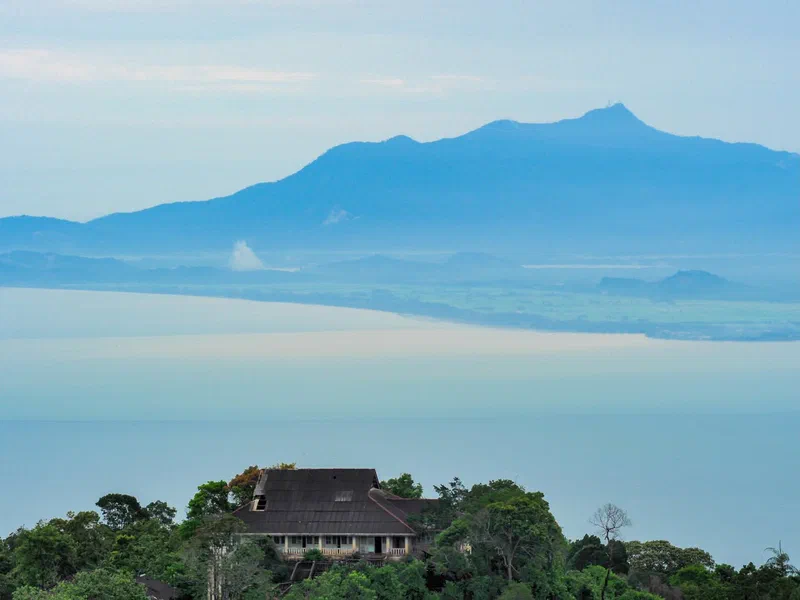
View of the old Crag Hotel (former Uplands School) from Bellevue Hotel (Halliburton’s Hill) with Kedah Peak (Gunung Jerai) in the background.
The rugged ridge with spectacular views of George Town and the North Channel was originally the property of William Armstrong Clubley, a senior member of the Presidency of Prince of Wales Island (Penang) who was a contemporary of Stamford Raffles. Clubley died in 1826 at age 36, likely of tropical disease; a common fate that befell early East India Company employees unused to the tropics. The hill was called Clubley’s Hill during his lifetime.
The Pinang Gazette of 9th August 1845 reported that “the piece of ground on the Great Hill on which Mr Bright is about to build a Sanatarium is to be called Mount Ellenborough”. It was named after Lord Ellenborough who had been the Governor-General of India until June the previous year. Bright had arrived from India to Penang to set up a sanatorium in the hills. Mr. Bright unfortunately failed to purchase an existing bungalow and was instead offered Clubley’s Hill which was undeveloped land.
“A Mr. Flood and Mr. Field have arrived”, it was reported on 30th September 1845, “to carry out the plans of Mr. Bright for maintaining a Sanatarium on the Great Hill”. The bungalow of his sanatorium on the newly named Mount Ellenborough was likely completed in 1847 and by 1854 it was already on a map. Dr John Bishop King, who attended to patients there referred to it as “Bright’s Bungalow” in 1860. However, by 1864 the doctor had referred to it as “the Crag”.
The property had in earlier times been called by the romantic-sounding name of “Wolf’s Crag” which, according to Mike Gibby, may have been inspired by Sir Walter Scott’s novel “The Bride of Lammermoor” published in 1819. Sir Walter Scott incidentally was a relative of James Scott, Captain Light’s business partner. In 1885, it was bought by Dutch tobacco planters from Deli in Sumatra and managed by a Mr. Middeldijk. In the 1890s a series of fires broke out and damaged some of the buildings. Two suspects were arrested but were later acquitted.
The Dutch then sold “The Crag” to Captain John Kerr from Poole, Dorset and his wife, Alice (née Loureiro) who was a Penang Eurasian. They took over the property from the Dutch in 1895 and turned it into a hotel. He employed “labourers to convey guests to the hotel by sedan chairs. The guests would wait at the hotel’s special depot at the old Alexandra Hotel at the entrance of the Botanical Gardens”. The hotel was an instant hit and became “a favourite honeymoon resort”.
Upon his retirement in 1905, Captain Kerr sold it to the Armenian Sarkies Brothers of E&O Hotel and Raffles Hotel fame. The Sarkies Brothers renovated and turned “The Crag” into “one of the most up-to-date resorts in the Far East”. The hotel’s business faltered during the First World War and to cut losses it was sold to the government for $275,000 although they managed it until 1929 when it was handed over to the Federated Malay States Railways. The hotel continued to make a loss until 1933. That same year it was taken over by the management of Runnymede Hotel.
During the pre-war years, business somewhat improved. The arrival of the Second World War would spell the end of the Crag’s days as a hotel. During the war, it was used as a leave resort by the German submariners based in Penang. It reopened on 1 May 1947 but it had become a shadow of its former self. The hotel lingered on until February 1954 when “the lessees”, once again, “the E and O Hotel relinquished the lease” causing it to cease operations.
Cecil Prosper Liston, a prominent Penang businessman, offered to lease “all the buildings etc, known as the ‘The Crag Hotel’ at a rental of $350 a month” to “run a Boarding School for children, of any nationality”. His proposal was rejected by the government in favour of the Incorporated Society of Planters of Malaya’s private school proposal. The school, aptly named Uplands, opened its doors to 52 children in January 1955 and was very popular. The school moved to Gurney Drive in 1977 and the Crag has remained abandoned ever since other than in 1992 and 2014 when it was briefly used to film the movie “Indochine” and the series “Indian Summers” respectively.
Sources:
- Keppel Garnier (1923), “Early Days of Penang”, JMBRAS Vol1. 1923
- Mike Gibby (2020), “The Bungalows of Penang Hill”, pg. 71-89
- The Singapore Free Press and Mercantile Advertiser (1845), 4 September 1845, pg. 3
- The Straits Times (1954), 28 March 1954, “Resort of romance is no more”, pg. 17
- The Straits Times (1845), “Penang”, 30 September 1845, Page 4
Photo by Eugene Quah Ter-Neng, 29 July 2020.
Uplands School