A Dutchman's Account of Penang in 1613

On Sunday, 28 November 1613, the East Indiaman “Globe”, belonging to the English East India Company (EIC), weighing 527 tons burthen, on the homeward leg of its journey, stopped by the island of Pulo Pinaon [Pulau Pinang] at the north entrance of the Straits of Malacca. This was the 7th voyage to the East Indies by the 10-year-old English trading company. A week earlier, Shakespeare’s play “Macbeth” had just been premiered back in England, at the Globe theatre. Malacca was then still in the hands of the Portuguese - which the Dutch had attempted a few times to take by force. The English were but minnows as a trading nation.
One of the founders of the EIC, Sir James Lancaster, had visited Penang 19 years earlier in 1592. He sojourned on Pulau Rimau - off the south coast of the main island - for three months for his crew to recover from scurvy.
The “Globe”, commanded by Captain Anthony Hippon, had started its journey in 1611. Curiously, on board on this trip was Peter Floris, a Hollander in his 30s who was a former employee of the Dutch East India Company, the VOC. Pieter Williemz van Elbing, a smooth-talking merchant with extensive knowledge of the East Indies trade, used the name Peter William Floris while working for the English - presumably to conceal his identity. After leaving the VOC he had joined the EIC. Naturally, the Dutch were not pleased that one of their own was working for the English company when they found out. This particular journey was in fact Floris’ idea, which he proposed to the EIC and even obtained the support of King James I. Prior to reaching Penang, the “Globe” had just opened a factory - trading outpost - at Ayutthaya and Pattani, a first for the EIC.
Floris noted in his journal, “Wee came to an ancker under Pulo Pinao [Pulau Pinang] att the W. syde [West side] att 10 faddem [fathom], being a greate iland, and founde the description of John Hugens to bee very true as well of the Straighte of Malacca as of this iland; for by his direction wee founde freshe water, being a little ile [Pulau Rimau] att the S. syde of the greate sand baye, and right over agaynste the little iland [Pulau Kendi] southward is a small baye [Teluk Kumbar] besette on both sydes with rockes, and is full of oysters, and by this baye is verye fayre [fair] water and easye to bee fetched. Wee sente our boate and skiffe ashoare to fetche water. Wee were come to an ancker to farre from the shoare, aboute 1 1/2 leagues, for wee mighte have come att 6 and 7 faddem, a good muddy grounde, within 1/2 league of the shoare”.
The John Hugens mentioned by Floris was his fellow countryman - Jan Huyghen van Linschoten - a spy, merchant, writer and traveller who divulged the navigational secrets of the Portuguese in his groundbreaking work “Itinerario” that greatly increased the knowledge of the Dutch and later the English regarding the East Indies.
The following day, Floris indulged in what tourists to this day still do: gorging on good Penang food: “I wente myselfe ashoare, and the oysters being so fayre and good I ate as many as made mee sicke”. Floris also discovered there had been another visitor after Lancaster’s 1592 visit: “Heere wee founde a Portingalls [Portugal’s] name, P° [Pedro] do Carvallo, a° [anno] 1596 Auguste, cutte in a tree”. Not wanting to be left out, he too left his mark - “whereuppon wee also cutte Globe van London, 1613, 29 November, for a signe”.
Interestingly, there is a place in Teluk Kumbar called Pasir Belanda; suggesting that the place had been a watering stop for the Dutch. Below is the map of the “Straights of Malacca” from “Itinerario” and a 1647 Dutch map showing the outline of Pulau Pinang in detail.
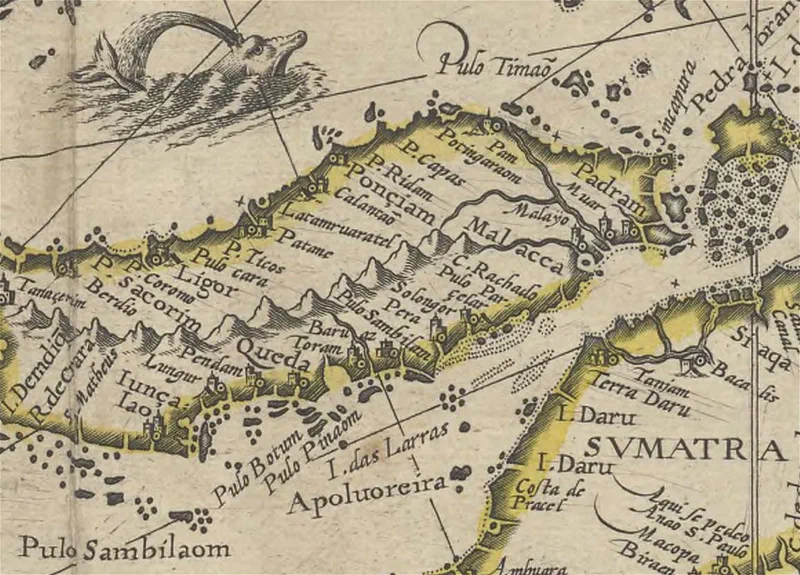
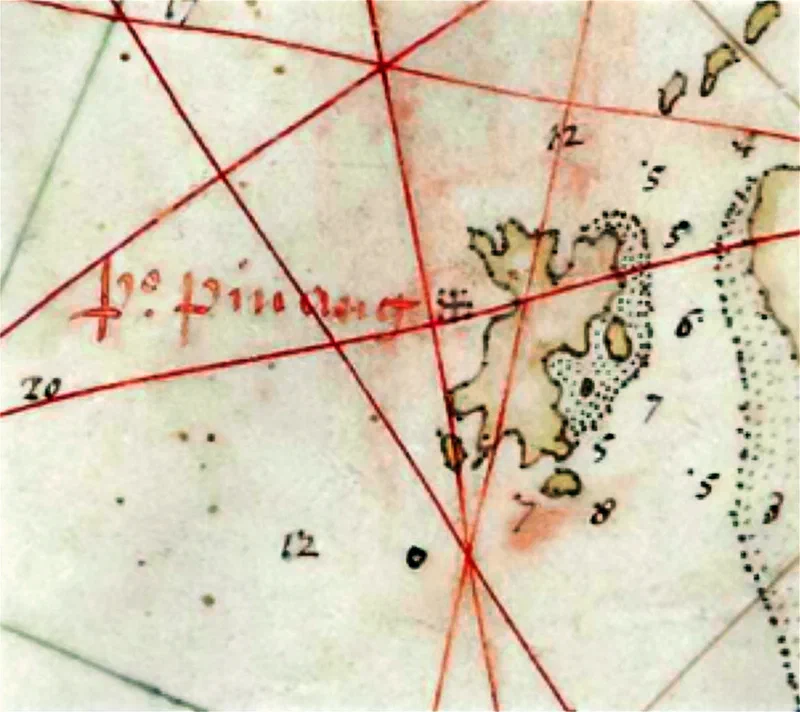
Source:
- Peter Floris (1613), “Peter Floris: His Voyage to the East Indies in the Globe 1611-1615, the contemporary translation of his journal”, edited by W.H.
Moreland, London, printed for the Hakluyt Society, 1934 - Bij Johan Blaeu (1647), “Kaart van Straat Malakka met de westkust van het schiereiland Malakka, de west- en oostkust van Sumatra”’, Map.
- India Office - Marine Department Records, IOMAR/L/MAR/A/XIII