February 2025

Browse the archive
202655
202558
202455
202338
202224

The Taiping Aerodrome (1931)

Kedah in the Unfederated Malay States (UMS) and Perak in the Federated Malay States (FMS) pioneered the first aerodromes in Malaya, marking a significant upgrade from the previous ad hoc landing grounds that were simply open spaces such as polo grounds. According to a Singapore press report from 16 April 1931, “the aerodrome at Alor Star was already in use” while “the Taiping landing ground will be useable in three months’ time.” Earlier that year in February, it was reported that “Federal Council at Kuala Lumpur, has contributed $120,000 for the aerodrome at Taiping, one of the chain throughout the Peninsula that the Air Ministry is urging speedy completion”. The Penang Aerodrome, built by the Straits Settlements government, would only open 4 years later on 29 September 1935. [See 12 September 2024 post]

The Taiping aerodrome’s first landing occurred on 6 November 1931, when two “R.A.F. [Royal Air Force] planes starting from Alor Star” landed at the facility after a 50-minute flight. “A large crowd witnessed the manoeuvres including the Resident [Bertram Walter Elles] and Mrs. Elles.” The press noted this milestone was “arousing rivalry at Ipoh, where the absence of preparations for a site is now raising a clamour for early action.” At this time, the aerodrome was “not yet provided with any buildings, hangars or other services, but petrol and oil are obtainable from Taiping.”

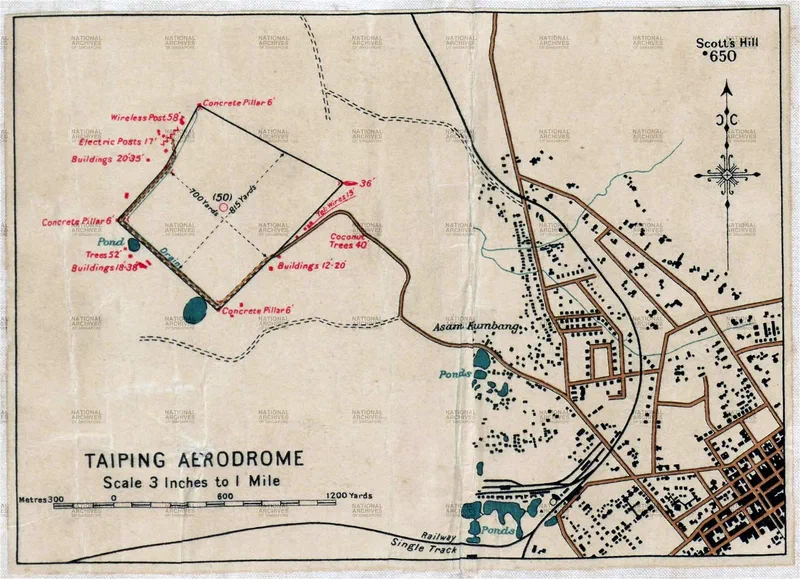
The aerodrome was situated “at an average height of 45 feet above sea level and is by road about 2 1/4 miles from the Government Office and 1 3/4 miles from the Taiping railway station… the area is roughly square in shape being 880 yards by 970 yards or 133 acres in extent.”

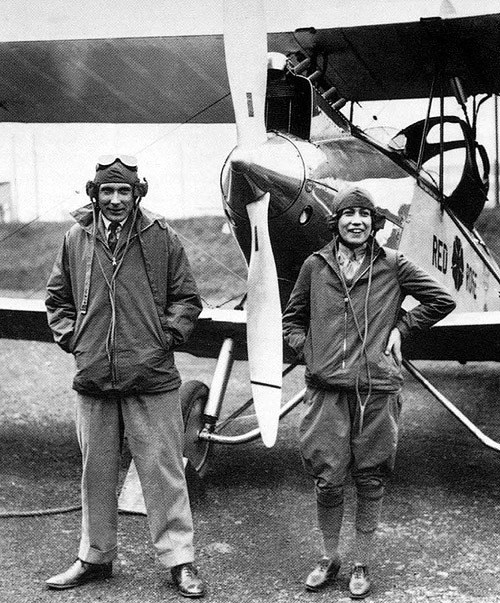
A common misconception is that the Taiping Aerodrome was the first one built by the British in 1928 (or thereabouts). In reality, there was no formal landing strip or aerodrome present before 1931. However, there was a landing in 1928 which involved an Avro-Avian light aeroplane named the Red Rose, piloted by Captain William Newton Lancaster with co-pilot Jessie Miller, during their historic England-to-Australia flight.

On January 5, 1928, after taking off from Victoria Point in Burma and heading for Penang, they were unable to find a safe landing location on the island despite considering the race course and beach. At 1:50 p.m., they decided to try for Taiping and landed there at 3 p.m. on the polo ground, which “was surrounded by hills and practically under water.” Notably, Jessie Maude Miller was the first woman to have flown to the Far East.
The Taiping Aerodrome (1931) — image 1
The Taiping Aerodrome (1931) — image 2

Sources:

  1. The Singapore Free Press and Mercantile Advertiser (1884-1942), 30 June 1928, “World Flyers’ Experiences”, pg. 7
  2. The Singapore Free Press and Mercantile Advertiser (1884-1942), 7 November 1931, “R.A.F. Visit Taiping”, pg. 11
  3. The Straits Budget, 16 April 1931, “Malaya’s Chain Of Aerodromes”, pg. 2
  4. The Singapore Free Press and Mercantile Advertiser (1884-1942), 21 February 1931, “Malaya Waking Up”, pg. 12


https://www.eugenequah.com/blog/the-taiping-aerodrome-1931/

Copyright © 2026 Eugene Quah Ter-Neng. All rights reserved.

The Early Days of the Francis Light School (est. 1930)

Unveiling the untold story of the founding and early days of the Francis Light School (S.K. Francis Light). Discover the unique events and figures that shaped the early days of this now 95-year-old institution.

Read more here:
https://www.penangmonthly.com/francis-light-school-and-the-dawn-of-merdeka/

https://www.eugenequah.com/blog/the-early-days-of-the-francis-light-school-est.-1930/

Copyright © 2026 Eugene Quah Ter-Neng. All rights reserved.

Amerigo Vespucci’s mention of Malacca (1504)

On Sunday, 28th October 1492, the Genoese explorer and navigator, Cristoforo Colombo - better known as Christopher Columbus - landed on the island of Cuba and claimed it for the King of Spain. Columbus believed “he had found the promontory called the Aureus Chersonesus” or the fabled Golden Chersonese - meaning Golden Peninsula; the name given to the Malay Peninsula by the ancient geographer Ptolemy. Beyond was his final destination - India; or so he thought. Columbus “himself did not realise he had found a new continent”.
This geographical misconception would later be corrected by another Italian, the Florentine navigator Amerigo Vespucci, who realised that they had found a continent previously unknown to the Europeans.

The German cartographer Martin Waldseemüller, after reading a published letter detailing the voyages of Amerigo Vespucci - known as the “Letter to Piero Soderini, gonfaloniere (1504)”, thought that, “I see no reason why anyone could properly disapprove of a name derived from that of Amerigo, the discoverer, a man of sagacious genius. A suitable form would be Amerige, meaning Land of Amerigo, or America…”. In April 1507, he published a map, Universalis Cosmographia, and named the new continent - America. This groundbreaking map was based on an earlier 1502 map, dubbed the Cantino planisphere after Alberto Cantino, an agent for the Duke of Ferrara, who successfully smuggled it from Portugal to Italy. “While yet in Lisbon, the probability is that Cantino interviewed [Amerigo] Vespucci, who had just returned to that city from his third voyage, and obtained from him supplementary information, which we assume to be the additional names in a cursive handwriting”.

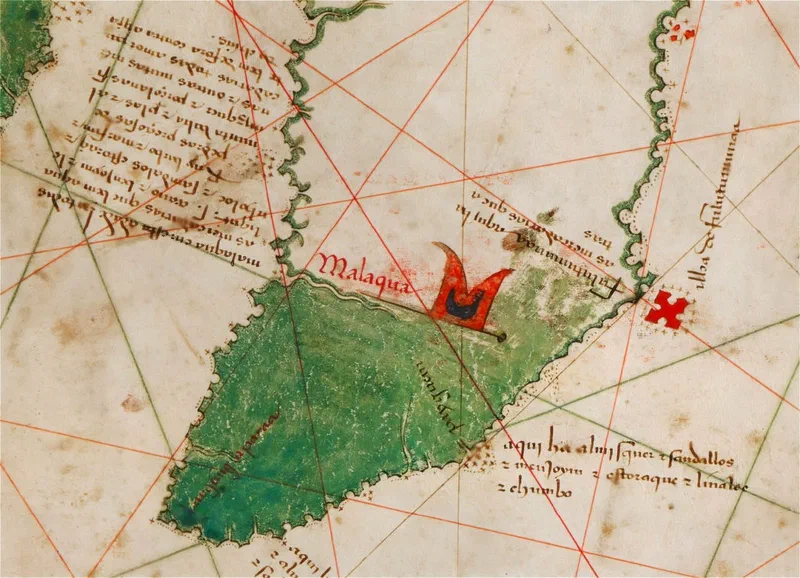
The “Cantino planisphere” shows Malaqua (Malacca) and the accompanying notes, written upside down, read as follows:

“Malaqua - in this city there is all the merchandise that comes to Calicut*, cloves and benzoin and lignaloes and sandalwood, storax and rhubarb and ivory and precious stones of great value and pearls and musk and fine porcelain; most of it comes from outside, on the side of the land of the Chinese”.

Amerigo Vespucci, writing about his fourth voyage in 1504, mentions Malacca by name and also Calicut as in the above note:

“We departed from this port of Lisbon, six consort ships, intending to go in quest of an island toward the east, called Melaccha, of which we have information that it is very rich and that it is, as it were, the emporium of all the ships that come from the Gangetic Sea and the Indian Sea, just as Cadiz is the port of call of all vessels passing from east to west and from west to east, [as this Most Serene King is informed,] on the route to Calicut…”

He never made it to Malacca.

* Calicut, a coastal city in the south Indian state of Kerala, is now known as Kozhikode.

Amerigo Vespucci’s mention of Malacca (1504) — image 1

Sources:

  1. Amerigo Vespucci (1504). “Lettera di Amerigo Vespucci delle isole nuovamente trovate in quattro suoi viaggi (1504)”
  2. Tennant J.S. (2021), “Columbus and the Idea of Cuba”, British Library - Americas and Oceania Collections blog
  3. Jim Siebold (1994), “#306 Cantino World Map”, Published in “Renaissance Maps: 1490-1800”. Monograph.
  4. James Johnstone (1926), “A Study of the Oceans”, pg. 82-83
  5. Jean Denucé (1908), “Les Origines de la Cartographie Portugaise et Les Cartes des Reinel”

https://www.eugenequah.com/blog/amerigo-vespuccis-mention-of-malacca-1504/

Copyright © 2026 Eugene Quah Ter-Neng. All rights reserved.

Fire Insurance Policy for the Chartered Bank Chambers

The Penang branch of the Chartered Bank of India, Australia and China was opened at 33 Beach Street on 11 January 1875. It later moved to 11-13 Beach Street.

The existing Standard Chartered Bank at No. 2 Beach Street was completed and opened on 30 January 1930. Designed by John McNeill and Charles Geoffrey Boutcher of the firm Stark & McNeill, the imposing 4-storey building was constructed over the site of the Central Police station which was demolished in 1925. At the time of completion it was one of the highest buildings in Penang.

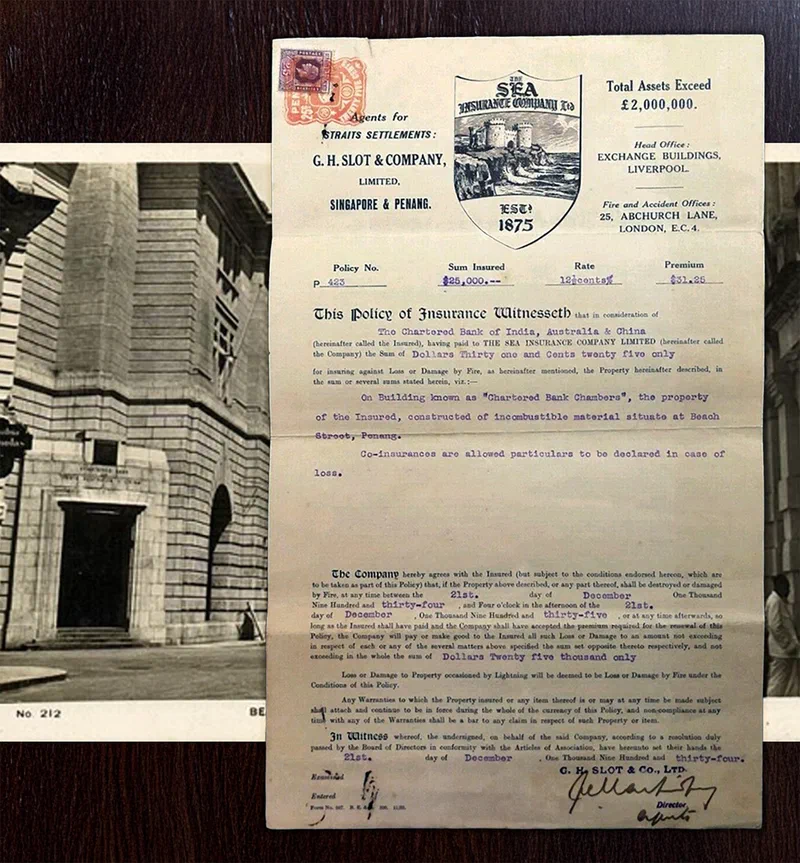
So how much was the premium for “insuring against Lost to Damage by Fire” the “Building known as the ‘Chartered Bank Chambers’ … constructed pf incombustible material situated Beach Street Penang”? Well according to the Policy shown below for the year “One Thousand Nine Hundred and thirty-four” (1934), it was a grand total of $32.24 with a stamp duty of 25 cents. The sum insured was $25,000.

Fire Insurance Policy for the Chartered Bank Chambers — image 1

Source:
Marcus Langdon (2015), “George Town’s Historic and Commercial & Civic Districts”

https://www.eugenequah.com/blog/fire-insurance-policy-for-the-chartered-bank-chambers/

Copyright © 2026 Eugene Quah Ter-Neng. All rights reserved.