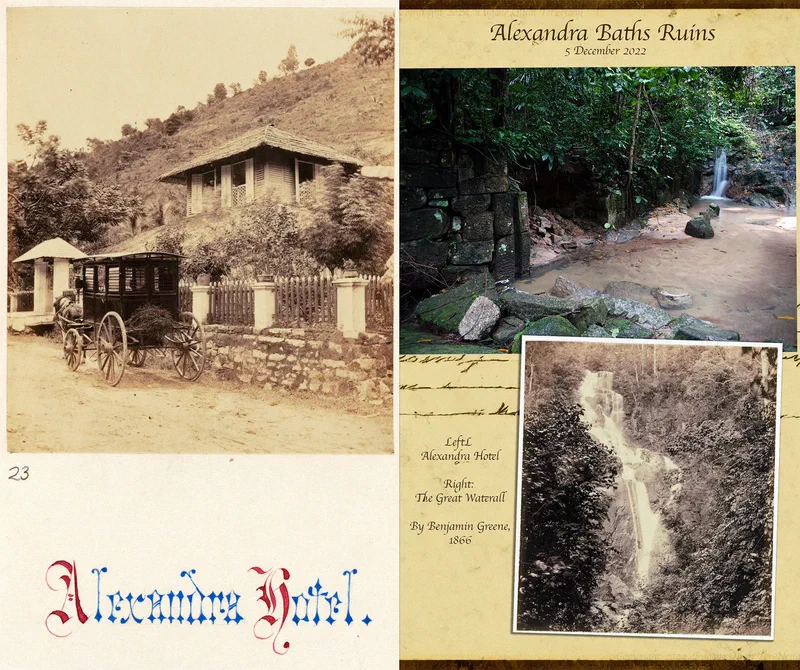
This previously unpublished photo, taken by Benjamin Greene in 1866 and kept by the National Library of Australia, was mislabelled as being a scene in China. It actually shows the Alexandra Hotel in Penang. It was located near the present Moon Gate near the entrance of the Penang Botanical Gardens. Another photo found in Greene’s collection was the nearby Great Waterfall of Penang which he visited.
The opening of the Alexandra Hotel was officiated by Sir Benson Maxwell in November 1863. It was reported that the main swimming bath was built of solid granite, measured 60 x 30 feet and 7 feet deep. The hotel was probably named after the then popular Princess Alexandra of Denmark (later Queen Alexandra) who had married Prince Albert Edward, the future King Edward VII, earlier in March that year. William Simpson who visited the hotel in September 1872 mentioned that it was “largely decorated with pictures of the Prince and Princess and their children, the Duke of Edinburgh, and other members of the royal family”.
It changed hands to Chia Choo Kin in 1875. Then in 1885, it was acquired by Cheah Chen Eok (the donor of the famous clock tower in town) as part of a property he called Villevue (town view in French). The current Moon Gate was the entrance to this property; it was restored after it was partially demolished in 2005. In 1896, the hotel was then renamed Waterfall Hotel and was briefly managed by J. Schwartz before reverting back to a Chinese manager. Around 1910, the government bought over the property and the surrounding lands in preparation to flood the Waterfall Gardens to make a reservoir. Luckily that didn’t come to pass. The hotel was last mentioned to be operational in December 1912 and presumably ceased operations after that.
During its heyday the hotel was known for its bathing pools known as the Alexandra Baths. The remnants of this bath are all that is left of the Alexandra Hotel today.
“Allen’s Indian Mail and Register of Intelligence for British & Foreign India, China, & All Parts of the East”, 16 October 1863.
William Simpson (1874), “Meeting the Sun: A Journey All Round the World Through Egypt, China, Japan and California, Including an Account of the Marriage Ceremonies of the Emperor of China”, pg. 91
Darton & Hodge (1863), “An historical record of the marriage of H. R. H. Albert Edward, Prince of Wales”
“The Waterfall Hotel”, “The Straits Independent and Penang Chronicle”, 12 February 1896, Page 5
Chia Choo Kin (1879), “Pinang Gazette and Straits Chronicle”, 23 July 1879, “Notice”, Advertisements Column 3, Page 6
The Straits Echo (Mail Edition), 21 October 1910, Page 959, “Supreme Court”
In episode 4 of People of Penang Podcast, join me and my co-host Moe (Mohammad Nasrullah Bin Zulkifli) as we chat with my dear friend, the prolific researcher and author Mike Gibby, about his work, life, and books.
Mike is known for his groundbreaking and beautifully illustrated books about Penang such as “Penang Hill: A Journey Through Time”, “Jerejak: Penang’s Untold Story”, “Penang Confidential” and “Street Art Penang Style”. His books are meticulously researched and often illuminate previously unstudied aspects of Penang’s local history, a testament to his formal training as a scientist.
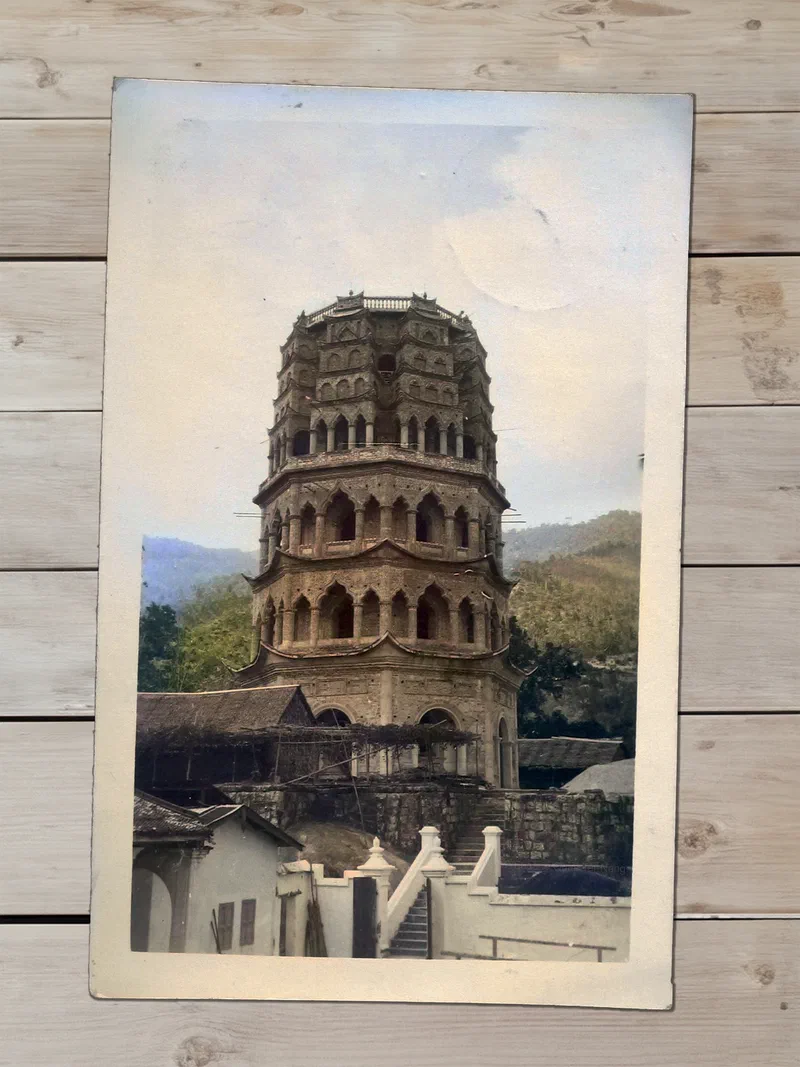
This rare postcard - digitally coloured - shows the Kek Lok Si pagoda under construction. It was sent to Switzerland on 19th June 1928 and eventually ended up in Bibliothek Zürich, Bildarchiv.
Written on it, in English, was the following, “This is the Pagoda of Ayer Itam, which is under construction, which I hope you would like Ayer Itam is a village where people go during their holidays. I will send you a view of the temple by next mail. Postmark 19.6.1928
The pagoda, officially called the Pagoda of Rama VI, is better known in Hokkien as Ban Po Thar (Pagoda of 10,000 Buddhas).
It was completed around August 1929. A letter to the Straits Echo on the 21st of that month mentioned that the pagoda had “recently been completed”. Mrs Lim Leng Cheak (Tan Say Seang Neoh) “was the chief donor”. “Her generosity, both in monetary contributions and in the supplying of cement for the building of the new pagoda, is always remembered with gratitude”, reported the press in 1947.
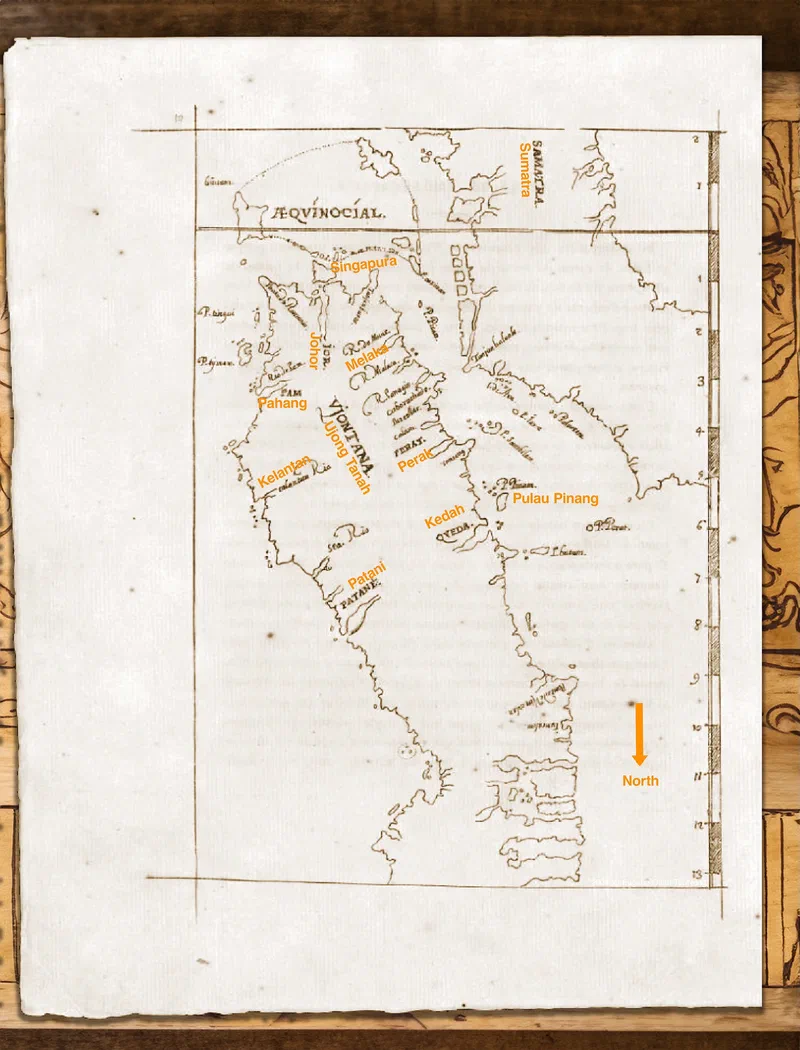
Manuel Godinho de Erédia’s map of the Straits of Malacca. He was a Bugis-Portuguese writer and cartographer who was born in Malacca. Queda (Kedah) and Pulo Pinam (Pulau Pinang) can be seen in this chart. It was probably based on his surveys before 1604, as he left for Goa the following year.
Translation and annotations mine:
In naval warfare, they [the Malays] employ different, smaller vessels, such as “lancharas” [lanchang] and “bantis” [brigantine], which are rowed by breast oars, and are likewise equipped with two rudders and masts. For fishing and river trade, they use “ballões” [boats - perahus/prau] and “nambangues” [prau tambang - ferry?], propelled by small hand-held oars, moving swiftly in harmony with the chanting of their rowers. From this, it may be inferred that the Malays do not engage in oceanic navigation, for they only sail by coasting along the shores of Viontana [Ujong Tanah, Land’s End - Johor], from the district of Pattane [Pattani], by the cape of the islet Pulo Catay (Pulo Cara/Ko Kra เกาะกระ) at the latitude of 8 degrees on the eastern coast, to the western coast of Viontana, at the same latitude in the district of Queda [Kedah], in Taranda [Trang] and Vion Calan [Ujong Salang - Phuket], which are regions where the Malay language is spoken.
It is noteworthy that the eastern coast of Viontana was settled and frequented before the western coast, as is evidenced by the histories, which reveal that Pattane and Pam [Pahang] were Malay territories before the founding of Malacca. The King of Pam [Pahang] governed Syncapura [Singapura], though the monarch resided in Pattane, the metropolis of the Malays, which was tributary to the empire of Siam, as the Malays to this day acknowledge its supremacy. However, the principal empire and governance were under the Emperor of Attay [Ayutthaya - Siam], as the Indies, both within and beyond, and the southern regions were tributaries, and their ports were open to oceanic navigation with vessels of a different design from those of Europe.
Notes: \
During Erédia’s time, the capital “V” in Portuguese when in front of a word sounded like “u”. \
The Dutch, French and English used the Portuguese spelling of Pulau Pinang (variously spelled as Pulo Pinão (Bocarro), Pulo Pinaon (Lancaster), Pulo Pinam (Erédia), Pulo Pinaom (Linschoten), etc.) \
bantis is a contraction for bargantis or bergantim (brigantine). Although in the Indian sense it refers to “smaller boats for rowing”.
Sternstein (1993), “The Journal of the Siam Society Vol. 81, Pt. II (1993)”, pg. 50-57
Casale (2014), “Ottoman Warships in the Indian Ocean Armada of 1538: A Qualitative and Statistical Analysis,” in Dejanirah Couto, Feza Günergün and Maria Pia Pedani, eds., “Seapower, Technology and Trade: Studies in Turkish Maritime History”
Hashmatrai Lekhraj Chablani (1929), “The Economic Condition of India During the Sixteenth Century”, pg. 64
In this third episode of the People of Penang Podcast, my co-host Moe (Mohammad Nasrullah Bin Zulkifli) and I had the pleasure of chatting with Lee Choo Chong, the editor of the Penang City Eye 城视报- a magazine “for the city folks of George Town”. This beautifully designed quarterly is the second longest running Penang magazine, featuring interesting articles about Penang history, culture and happenings. Lee Choo shared her inspiring journey of how she and her husband launched the magazine and have kept it thriving to this day. Don’t miss out on this captivating story of passion and perseverance!
The second episode of the People of Penang Podcast is out! This time, we had the pleasure of chatting with the fabulous Siti Hajar Mohd Yunus from Tourism Malaysia about all things tourism - especially in relation to Penang - and as usual some other random topics.
Joining us was the well-known Penang tour guide, Tger Tatt, who once got lost in the jungle but can navigate George Town with his eyes closed. 🐯🌴 (Yes, you read that right! 😂)
And in true unscripted fashion, my co-host Moe (Mohammad Nasrullah Bin Zulkifli) decided the floor was the best seat in the house. 🤷♂️ Why? Only Moe knows! 🤣 Tune in for laughs, insights, and a whole lot of Penang love.
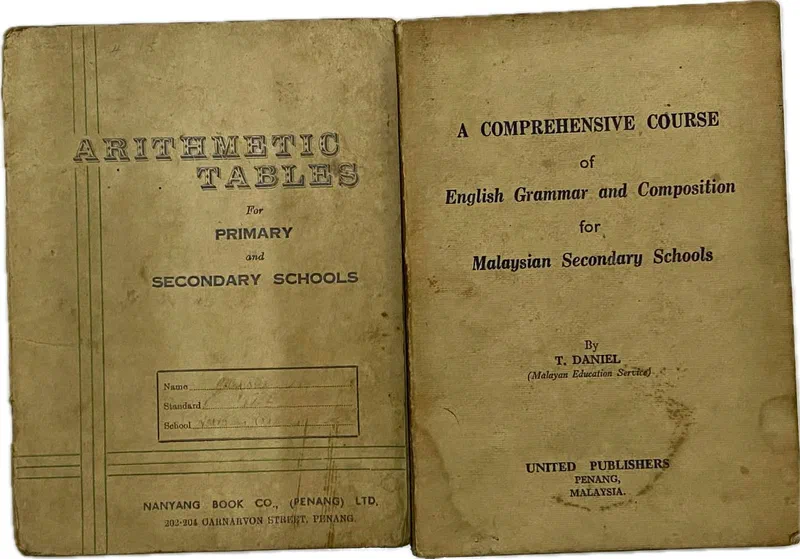
Two 1960s era school books. The one on the left was published in 1963 by Nanyang Book Co. (Penang) Ltd. located at 202-204 Carnarvon Street. The other one on the right was published in 1964 by United Publishers and distributed by United Book Company at 187-189 Carnarvon Street.
Thanks to everyone on season 1 of the People of Penang Podcast for sharing your amazing stories with us. 🙏
Season 1 guests (in order of appearance) : Lindsay Gasik, Rexy Prakash Chacko, Siti Hajar Mohd. Yunus, Lee Choo Chong, Mike Gibby, Jason Blaikie Fsc, Jason Selvanayagam, David ST Loh, Rebecca Loh, Yuen Darren, Lillian Tong, Tropical Spice Garden (Katharine & Kenneth), Nasha Rodziadi Khaw
I’m excited to share our inaugural episode of the People of Penang Podcast which I’m hosting with the founder of Penang Hidden Gems - the former radio and TV personality - Moe (Mohammad Nasrullah Bin Zulkifli). In this episode we talked to author, hiking expert, orchid enthusiast and engineer, Rexy Prakash Chacko about the natural wonders of Penang, work-life balance, orchids and more.