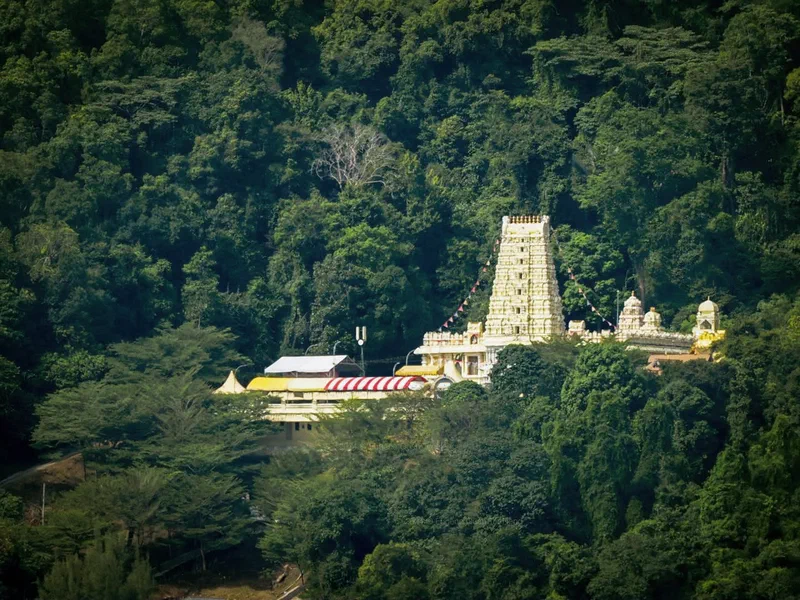
The Waterfall Hilltop Temple or officially known as Arulmigu Balathandayuthapani Kovil (அருள்மிகு பாலதண்டாயுதபாணி திருக்கோவில்) is dedicated to Lord Murugan. Perched on the side of a hill, it is the focal point of the recent Thaipusam festival celebrations. Devotees would climb up over 500 steps to reach this temple during this annual festival. It was completed in 2012 at a cost of RM 10 million.
The Hindu temple consecration ceremony is called Kumbhabhishekam. Literally, it means the “sprinkling” (abhishekam) of the temple with sacred waters carried in a “water-pot” (kumbha). This important ritual was performed on 29th June 2012 for the newly completed Waterfall Hilltop temple. The main tower, called a gopuram, is 21.6m high (approximately equivalent to a 7-storey building). The older temple built in 1985 is 30m below the current one, which itself was a replacement of the original shrine which once stood near the Great Waterfall for most of the 19th century.
There is, regrettably, much inaccurate historical information regarding the earlier incarnations of this temple. I will be writing an article on the history of the Waterfall Temple in the near future based on official records.
This photo of the temple was shot from 3km away in the Penang Strait during the recent Thaipusam Festival.
Sources:
Penang Monthly, Teo Sue Ann, August 2012, “Kumbabhishekam”
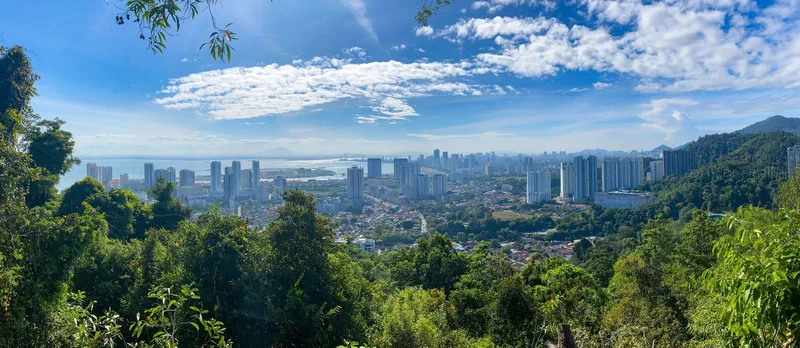
This is a rarely seen panoramic view of the northeast side of Penang with George Town in the distance from the south side of the summit of Mount Erskine (Pearl Hill), 200m above sea level. Jason Selvanayagam and I hiked up to this viewpoint from the ridge that starts at Pepper Estate on a beautiful morning.
On the horizon, the Strait of Penang, Bukit Mertajam on the mainland and the first Penang Bridge can be seen. The Guillemard Reservoir and Mount Olivia are also visible on the middle right part of the frame.
Due to its strategic location which offers a commanding view of the North Channel, George Town and the Penang Strait, Mount Erskine was once a flagstaff and signal post mountain in the early 19th century. It was later host to a coastal artillery Fire Control Post during the Second World War. The abandoned buildings of this post still dot the peak, some in relatively good condition.
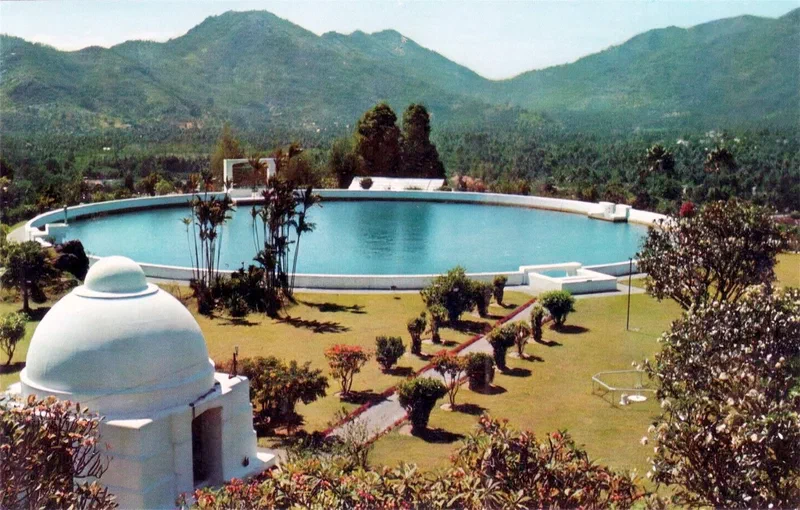
Ayer Itam Reservoir was completed in 1915 under the supervision of Municipal Engineer Leonard Moore Bell, dubbed the “Christopher Wren” of Penang by his fellow engineers. Bell Road was named in his honour. Bell hired James Dollery Fettes, a talented young engineer from South Africa, to be his assistant and work on the waterworks. Most of the construction and design work was delegated to Fettes. According to Fettes, the “service reservoir works were built by administration from 1911 to 1915.” Fettes left Penang to fight in the Great War as soon as the reservoir was completed.
Perched on a highland spur above Ayer Itam, 270 ft above sea level, this reservoir features a perfectly circular pool with a capacity of 4,149,000 gallons, a “dome recorder house,” manicured gardens, and a clock tower. It was once a popular public park with a commanding view of the Ayer Itam Valley before being closed to the public in the 1960s.
Source: James Dollery Fettes (1923), “Notes on the Penang Water Supply”, Published in the September 1923 edition of the Far Eastern Review, pg. 591-595
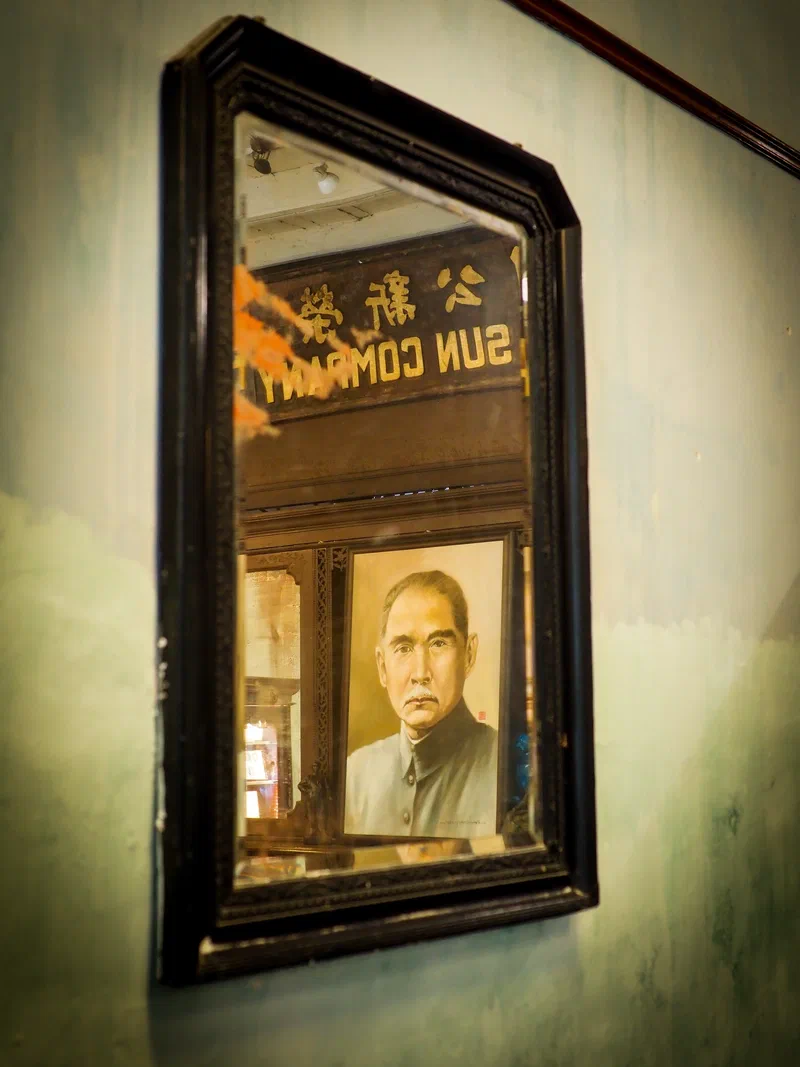
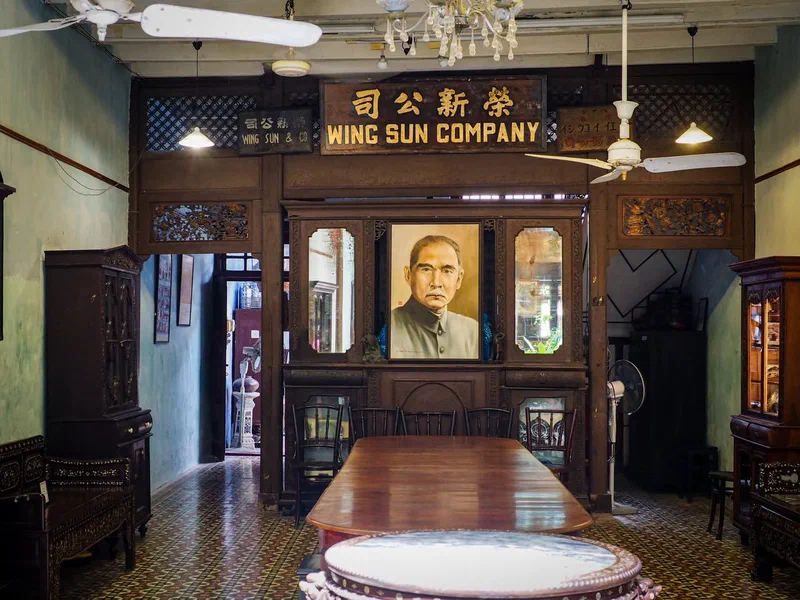
Dr. Sun Yat-sen (Sūn Zhōngshān, 孫中山) was the leader of the Chinese Republican Revolution and served as the first provisional president of the Republic of China. The “dedication of his Penang supporters” was vital in “shoring up the Xinhai Revolution after the Wuchang Uprising on 10th October, 1911”. Dr. Sun stayed at Dato’ Kramat while the Nanyang (Southeast Asia) Headquarters of the movement was at No. 120 Armenian Street.
Source: Khoo Salma Nasution (2008), “Sun Yat Sen in Penang”
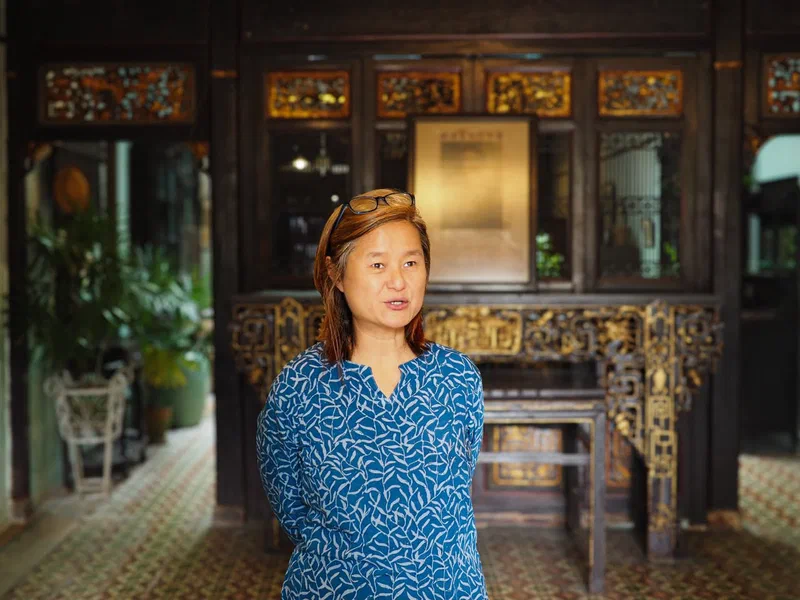
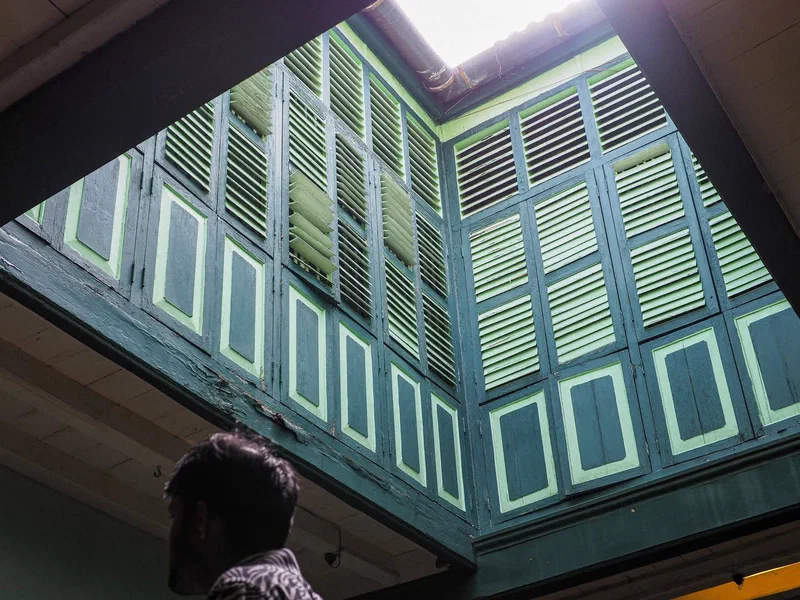
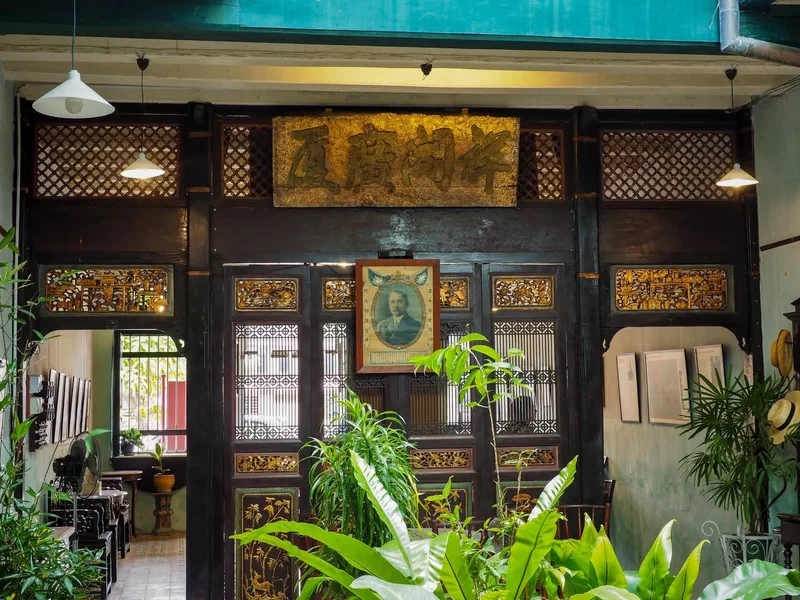
This building was later owned by a merchant named Ch’ng Tong Swee. Today, the shophouse serves as the “Sun Yat-sen Museum Penang” and is curated by his granddaughter, the historian Khoo Salma. According to her, “this house has been preserved to remember the role that a group of people in Penang played in the 1911 Chinese Revolution, a major event in world history”.
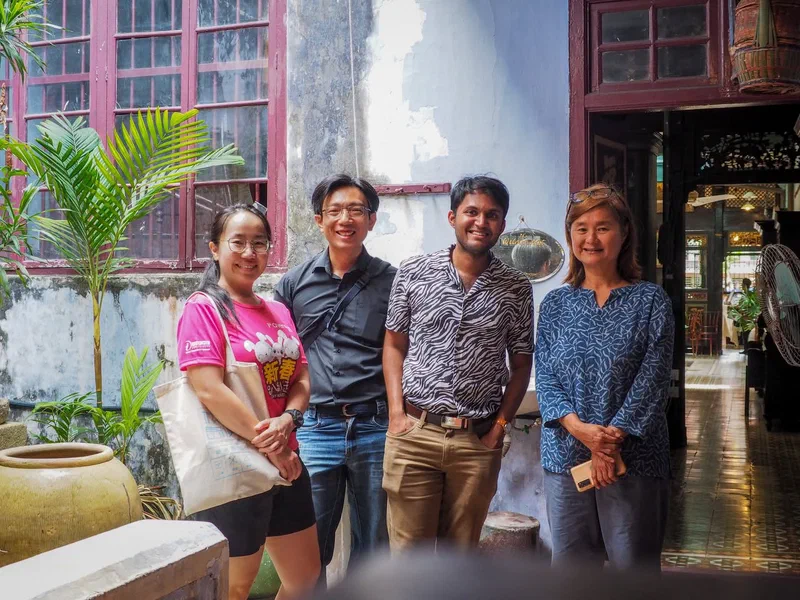
She gave us a guided tour of the museum which has just reopened after undergoing refurbishment. The house is immaculately maintained with informative exhibits hung on the walls. It was well worth the admission price of RM 10.
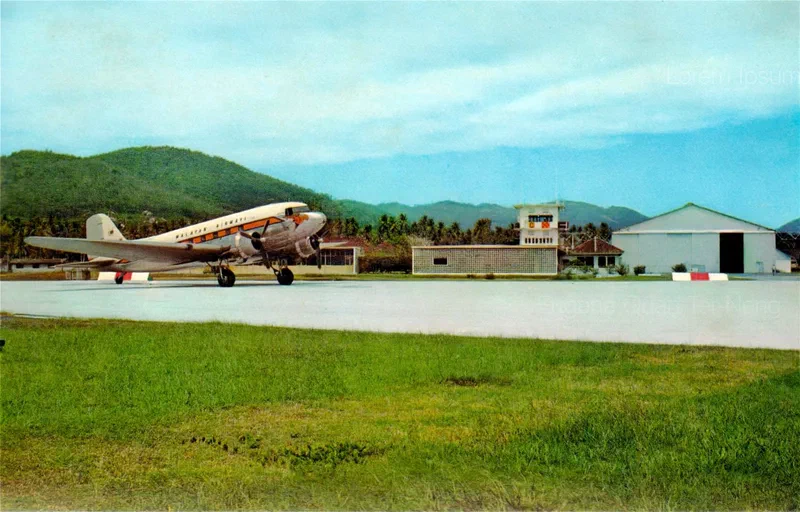
Photo of a Malayan Airways Douglas DC-3 at the Penang Aerodrome. Malayan Airlines started to operate this type of aircraft in April 1960 and it changed its name to Malaysian Airways in 1963 when the Federation was formed. This photo must have been taken between those two dates.
The current Penang International Airport started as the Penang Aerodrome.
On 3 January 1931, the Malaya Tribune reported that the government intended to acquire “about 250 acres of land in the district of Bayan Lepas (Penang) for the purpose of an aerodrome”. An aerodrome is a small airport.
David Alexander Murray “Dammy” Brown, a descendant of David Brown who was once Penang’s largest landowner, told the Supreme Court in February 1932, that the “aerodrome site was part of the Glugor Estate which belong to his family and which he managed”. “In 1927 a large block of the whole of Lot 637 was put up for public auction”. It was bought by Yeap Chor Ee, a prominent businessman who founded Ban Hin Lee Bank. Dammy Brown testified that “the land before he sold it to Mr. Yeap Chor Ee was mostly padi”. Yeap had taken the government to court when it wanted to acquire part of the land sold to him by Brown. The government wanted to pay Yeap $41,000 for 278 acres while he demanded $111,000. Yeap lost the case.
In June 1932, the tender to construct “a landing ground for the civil aerodrome” was awarded to Phang Pak Hiong whose tender at $45,063 was the lowest. By the middle of March, 1934 the new aerodrome “has been passed as serviceable for use in dry weather”. On 10th November, H.L. Brooks, en route to Melbourne, landed at the yet-to-be-opened aerodrome at 7:30 a.m.
On Sunday, 29 September 1935, the “Penang Aerodrome with its magnificent metalled runway was formally opened when the Imperial Airways homeward bound plane ‘Arethusa’ made a perfect landing at 9.10 a.m.” where “a large crowd of local residents” were there to greet its arrival.
Sources:
“Much better than Alor Star - H.L. Brooks Lands this Morning”, Pinang Gazette and Straits Chronicle, 10 Nov 1934, pg. 16
“Expert Evidence in Land Acquisition”, Pinang Gazette and Straits Chronicle, 5 Feb 1932, pg. 7
“Aerodrome at Bayan Lepas”, Malaya Tribune, 6 Jun 1932, pg. 9