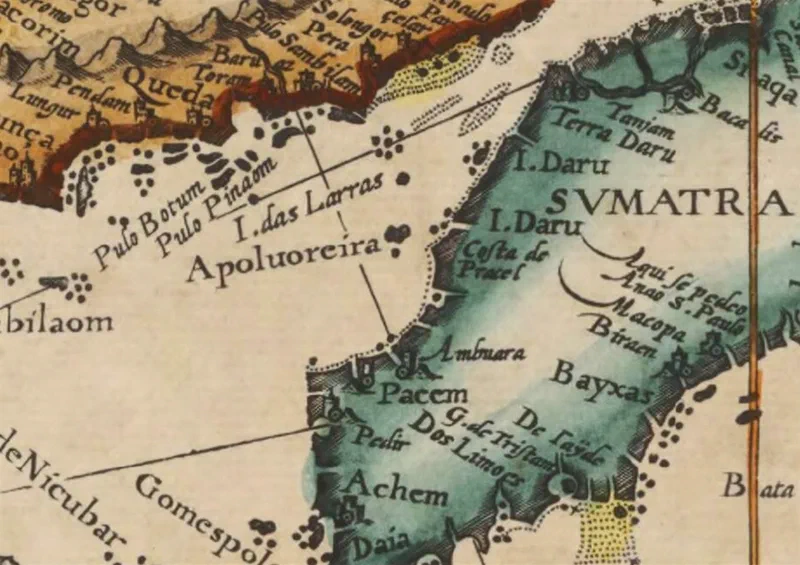
Map of the Straits of Malacca published in 1596 showing Penang (Pulau Pinaom) and Kedah (Queda).
The Dutch merchant, adventurer and writer Jan Huyghen van Linschoten copied, while in Goa in the 1580s, the nautical charts which were a closely kept secret by the Portuguese for over a century. He also amassed a vast amount of descriptions of the countries, trading routes and navigational information collected from the cosmopolitan residents of Goa he met. This act of trade espionage would ultimately reshape the world.
In 1596, he published the information in his book, “Itinerario: Voyage ofte schipvaert van Jan Huygen van Linschoten naer Oost ofte Portugaels Indien, 1579-1592” (Travel account of the voyage of the sailor Jan Huygen van Linschoten to the Portuguese East India). This precious knowledge enabled the Dutch and later the British to break Portugal’s monopoly of East Indian trade. And this indirectly led to the creation of the British East India Company which then facilitated the rise of the British Empire.
His book contains what is likely the earliest written account of Pulau Pinang, spelt as Pulo Pinaon or Pinaom:
“This Island Pulo Pinaon lyeth 5. miles from the firme land, full under five degrees and 1/4 the marke thereof is, that it is high in the middle, having on the North point a round houvell [hill] and an Island lying in the middle way from the same Island, and coming along by the land, it hath a great creek with a sandy strand …”
Although published in 1596, it predates the account of Sir James Lancaster, who was the first named European to have visited Penang in 1592. This is because Linschoten collected his description of Penang between 1579 and 1592. Lancaster also called the island by the Portuguese pronunciation of its Malay name.
Sources:
Jan Huygen van Linschoten (1596), “Itinerario: Voyage ofte schipvaert van Jan Huygen van Linschoten naer Oost ofte Portugaels Indien, 1579-1592”
Petrus Plancius (1596) - Map - “Exacta & accurata delinatio cúm orarum maritimarum túm etjam locorum terrestrium quæ in regionibus China, Cauchinchina, Camboja, sive Champa, Syao, Malacca, Arracan & Pegu”
Clements R. Markham (1877), “The voyages of Sir James Lancaster, Kt., to the East Indies”
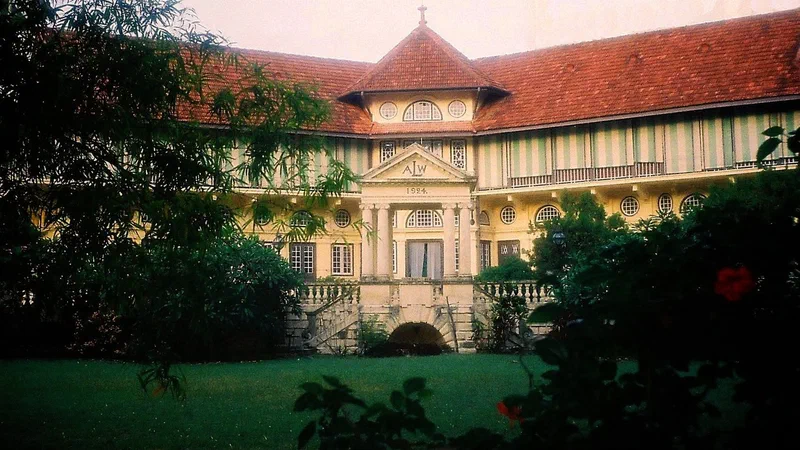
Photo of the now 99-year-old Loke Villa (or Loke Mansion) taken in 2014 using an antique Olympus Trip 35 film camera.
Scottish architect David McLeod Craik was commissioned by Alan Loke Wan Wye (陸運懷), the son of Malayan business magnate Loke Yew (陆佑) who was a pioneer and founding father of modern Kuala Lumpur. Alan Loke married Lam Chooi Lan, the granddaughter of Kapitan China Chung Keng Kwee. He died in October 1941.
Alan Loke’s initials, ALW, can be seen on the tympanum of the arch of the main entrance of his gorgeous sea-facing Tropical Arts and Crafts style villa. It was built in 1924 next to the St. Joseph’s Novitiate (now part of the Gurney Paragon complex) which incidentally was also designed by Craik.
Sources: PHT Newsletter Issue No.105 / July 2014 中國近代名人圖鑑, pg. 419 Biographical Dictionary of the Mercantile Personalities of Penang Photo by Eugene Quah Ter-Neng, 2014
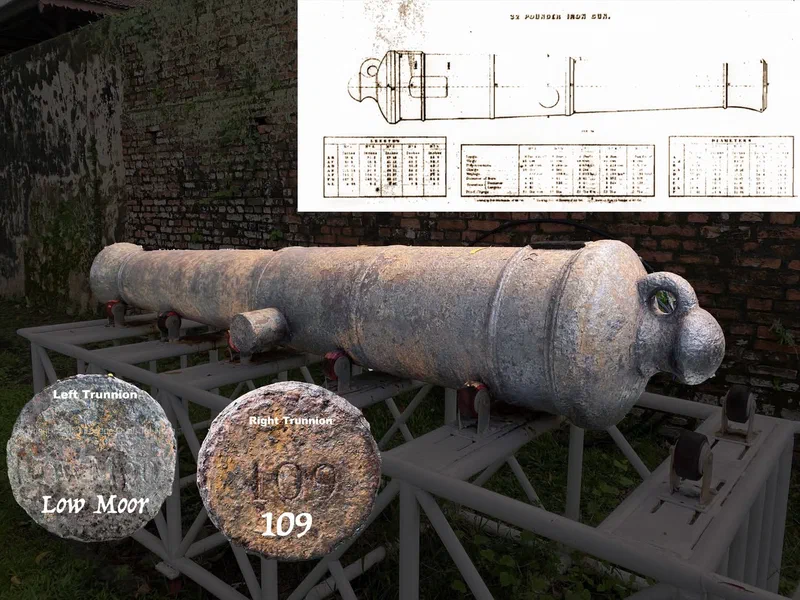
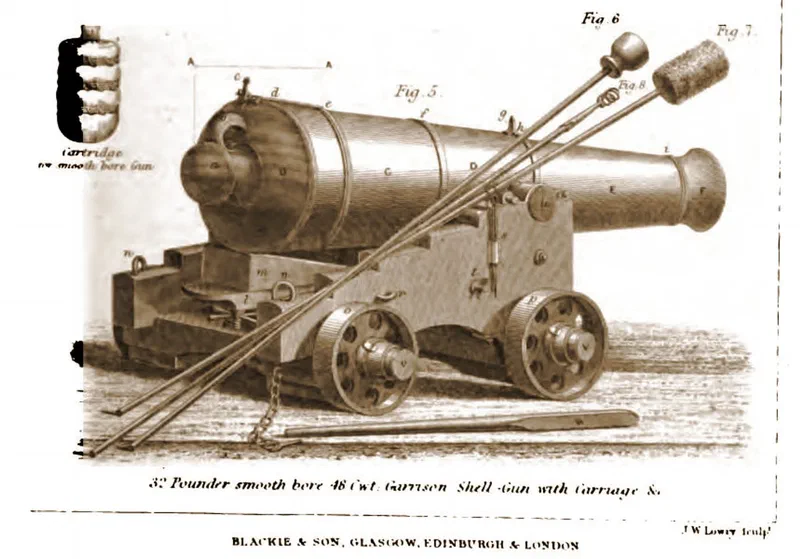
When I was at Fort Cornwallis this morning, I noticed there was a collection of cannons unearthed between 2019 and 2020 during the excavation of the moat. These cannons, now displayed near the main entrance, had previously undergone a process of restoration by archaeologists at USM before being returned to the fort. Regrettably, no information was provided for these displayed cannons, some showing significant signs of corrosion. I recognised one of the cannons as a Blomefield due to its distinctive loop on the breech. Its shape bore a striking resemblance to the cannon at the Wellesley school and the other 32-pounders incorrectly mounted on the parapets since WW2. Despite its topside markings being illegible, luckily the marking on the left and right trunnions - the supporting cylindrical projection on each side of the cannon - could still be read. The left trunnion bears the inscription, almost illegible, “Low Moor,” indicating the foundry, while the right trunnion displays clearly “109,” the manufacturer’s serial number – the 109th unit of the batch that was cast using the same pattern.
The Low Moor Ironworks, established near Bradford in 1791, commenced the casting of Blomefield pattern cannons a year later, in 1792. This suggests that the creation of the cannon occurred after this date. In March 1810, the Penang Presidency government informed the Directors of the East India Company that “a detailed Fascine Battery has recently been commenced upon, situated on the Beach of the Esplanade” and that it was “intended to mount not less than Seven heavy Guns 32 Pounders”. Years earlier, at the start of the Presidency, in November 1805, Colonel Norman Macalister reported the presence of eight heavy guns at the “half moon Battery” east of the Government House. It is plausible that these guns may have been reused at the new Fascine Battery constructed in 1810. The 32-pounder at Wellesley school and similar ones on the parapets were manufactured within a year of each other, 1797-1798.
This newly found cannon, having the profile of a typical Blomefield 32-pounder, is likely one of the eight heavy guns mentioned by Macalister, forged during the same period as the other cannons mentioned earlier.
Sources:
David McConnell (1988) “British Smooth-Bore Artillery”, pg. 61-62 Straits Settlements Factory Records, Vol. 26, Council Proceedings, 15 March 1810, pg. 403-406 Straits Settlements Factory Records, B1, 19 November 1805, pg. 60-65 Marcus Langdon, “Penang the Fourth Presidency of India, 1805-1830, Volume 1, Book 1 - Fort Cornwallis”, pg. 59, 83 London Society, Volume 36, “The Low Moor Company”, pg. 347
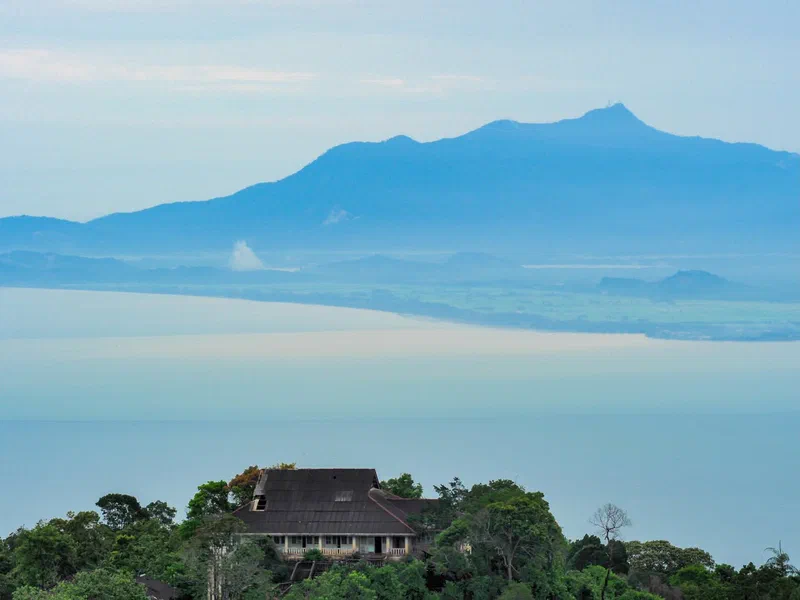
View of the old Crag Hotel (former Uplands School) from Bellevue Hotel (Halliburton’s Hill) with Kedah Peak (Gunung Jerai) in the background.
The rugged ridge with spectacular views of George Town and the North Channel was originally the property of William Armstrong Clubley, a senior member of the Presidency of Prince of Wales Island (Penang) who was a contemporary of Stamford Raffles. Clubley died in 1826 at age 36, likely of tropical disease; a common fate that befell early East India Company employees unused to the tropics. The hill was called Clubley’s Hill during his lifetime.
The Pinang Gazette of 9th August 1845 reported that “the piece of ground on the Great Hill on which Mr Bright is about to build a Sanatarium is to be called Mount Ellenborough”. It was named after Lord Ellenborough who had been the Governor-General of India until June the previous year. Bright had arrived from India to Penang to set up a sanatorium in the hills. Mr. Bright unfortunately failed to purchase an existing bungalow and was instead offered Clubley’s Hill which was undeveloped land.
“A Mr. Flood and Mr. Field have arrived”, it was reported on 30th September 1845, “to carry out the plans of Mr. Bright for maintaining a Sanatarium on the Great Hill”. The bungalow of his sanatorium on the newly named Mount Ellenborough was likely completed in 1847 and by 1854 it was already on a map. Dr John Bishop King, who attended to patients there referred to it as “Bright’s Bungalow” in 1860. However, by 1864 the doctor had referred to it as “the Crag”.
The property had in earlier times been called by the romantic-sounding name of “Wolf’s Crag” which, according to Mike Gibby, may have been inspired by Sir Walter Scott’s novel “The Bride of Lammermoor” published in 1819. Sir Walter Scott incidentally was a relative of James Scott, Captain Light’s business partner. In 1885, it was bought by Dutch tobacco planters from Deli in Sumatra and managed by a Mr. Middeldijk. In the 1890s a series of fires broke out and damaged some of the buildings. Two suspects were arrested but were later acquitted.
The Dutch then sold “The Crag” to Captain John Kerr from Poole, Dorset and his wife, Alice (née Loureiro) who was a Penang Eurasian. They took over the property from the Dutch in 1895 and turned it into a hotel. He employed “labourers to convey guests to the hotel by sedan chairs. The guests would wait at the hotel’s special depot at the old Alexandra Hotel at the entrance of the Botanical Gardens”. The hotel was an instant hit and became “a favourite honeymoon resort”.
Upon his retirement in 1905, Captain Kerr sold it to the Armenian Sarkies Brothers of E&O Hotel and Raffles Hotel fame. The Sarkies Brothers renovated and turned “The Crag” into “one of the most up-to-date resorts in the Far East”. The hotel’s business faltered during the First World War and to cut losses it was sold to the government for $275,000 although they managed it until 1929 when it was handed over to the Federated Malay States Railways. The hotel continued to make a loss until 1933. That same year it was taken over by the management of Runnymede Hotel.
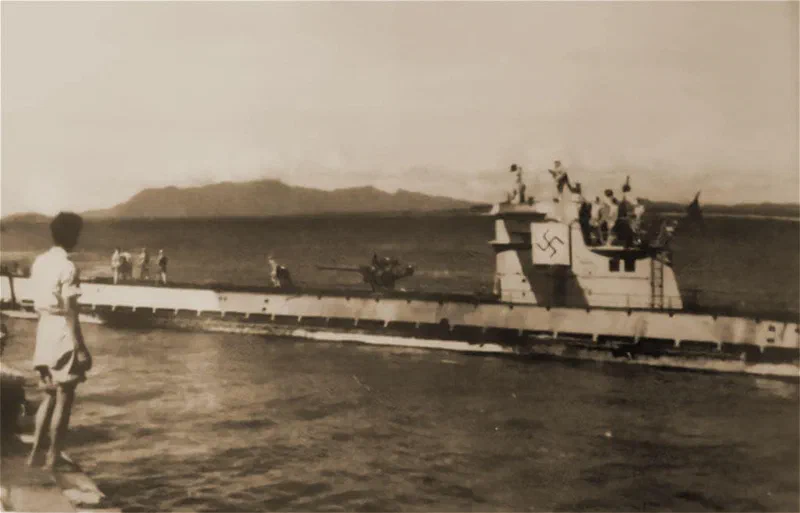
During the pre-war years, business somewhat improved. The arrival of the Second World War would spell the end of the Crag’s days as a hotel. During the war, it was used as a leave resort by the German submariners based in Penang. It reopened on 1 May 1947 but it had become a shadow of its former self. The hotel lingered on until February 1954 when “the lessees”, once again, “the E and O Hotel relinquished the lease” causing it to cease operations.
Cecil Prosper Liston, a prominent Penang businessman, offered to lease “all the buildings etc, known as the ‘The Crag Hotel’ at a rental of $350 a month” to “run a Boarding School for children, of any nationality”. His proposal was rejected by the government in favour of the Incorporated Society of Planters of Malaya’s private school proposal. The school, aptly named Uplands, opened its doors to 52 children in January 1955 and was very popular. The school moved to Gurney Drive in 1977 and the Crag has remained abandoned ever since other than in 1992 and 2014 when it was briefly used to film the movie “Indochine” and the series “Indian Summers” respectively.
Sources:
Keppel Garnier (1923), “Early Days of Penang”, JMBRAS Vol1. 1923
Mike Gibby (2020), “The Bungalows of Penang Hill”, pg. 71-89
The Singapore Free Press and Mercantile Advertiser (1845), 4 September 1845, pg. 3
The Straits Times (1954), 28 March 1954, “Resort of romance is no more”, pg. 17
The Straits Times (1845), “Penang”, 30 September 1845, Page 4
Did you know Penang once was a submarine base shared by both the Japanese and German navies?
Using actual ship logs from the U-boats and declassified Allied interrogation reports, this article provides a glimpse of this little-known part of Penang’s history through the eyes of the German sailors themselves.