Keeping Penang's Story Real in the Age of Artificial Intelligence
Précis
This précis was automatically generated based on the full article text.
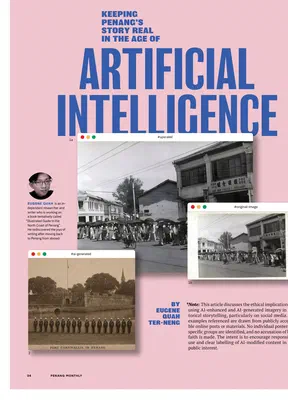
Strikingly sharp colour photos of old Penang now circulate widely on social media. One, of Fort Cornwallis, was shared in a 100,000-member Facebook group, and apparently no one noticed it was a black-and-white 1865 photograph coloured by AI. Eugene Quah explains three kinds of AI image: colourised, ‘upscaled’ (enlarged, sometimes with garbled details) and entirely invented. He proposes simple labels such as #ai-coloured, #ai-upscaled and #ai-generated.
He then ‘interviews’ a confident historian, ‘Professor Oh Peng Ai’, who says the Goddess of Mercy Temple on Pitt Street dates from 1728, decades before George Town existed. The professor is really ChatGPT. Like the person in John Searle’s ‘Chinese Room’ thought experiment, it produces fluent answers without understanding, and it can ‘hallucinate’ false facts.
He does not call for a ban on AI. He suggests Penang’s heritage groups agree on clear AI-content rules, educate members that chatbots are not reliable sources, and use their many volunteers to check facts. AI can be a helpful co-pilot, but humans must stay the pilot.
Key points
- The source photo was taken by John Thomson in 1865.
- Upscaling works reasonably well up to 2x. Repeated upscaling adds errors such as distorted faces and garbled text.
- Expecting readers to fact-check everything is unrealistic, so trustworthy sources matter.
- Yuval Harari notes that truth is costly to produce while fiction is cheap.
- The article names no individual posters or groups, and accuses no one of bad faith.
Why it matters
As AI tools spread, Penang's shared memory could be quietly rewritten. The essay offers practical, community-based ways to keep heritage honest.
- Places
- Fort Cornwallis, Pitt Street, George Town, Penang
- Subjects
- AI image colourisation, ChatGPT, Chinese Room argument, John Thomson, Fort Cornwallis