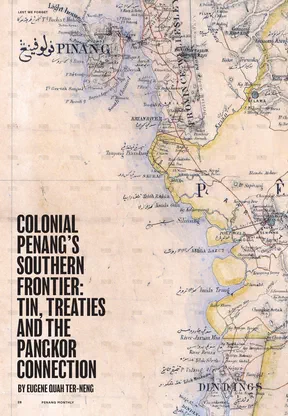
Colonial Penang's Southern Frontier: Tin, Treaties and the Pangkor Connection
Précis
This précis was automatically generated based on the full article text.
Pangkor island, off the Perak coast, has been known to sailors for centuries. An Arab navigator mentioned it in 1511, and its name may come from Thai words meaning ‘island barrier’. The Dutch built forts there in the 1600s and 1700s, and the ruins of the second, stone fort survive.
In the mid-1800s Penang businessmen financed the rich tin mines of Larut in Perak. Rival Chinese societies, the Hai San and Ghee Hin, fought violent wars over them, which spilled into Penang. In 1874 Governor Andrew Clarke gathered the Malay chiefs and Chinese leaders at Pangkor and signed a treaty with Raja Abdullah that brought peace, founded the town of Taiping (‘Eternal Peace’) and began direct British involvement in the Malay states.
The treaty was signed on a table made for the house of a Kedah Malay settler, Haji Mat Akib. Its later owners suffered a murder and a stabbing. Britain also used an awkward English translation of an 1826 treaty to claim a strip of the mainland, the Dindings, which was run from Penang until 1935. Pangkor’s Chinese fishermen still speak Penang Hokkien.
Key points
- The name 'Dinding' may come from Thai 'Din Daeng' (red earth). Lumut is still called 'Tanah Merah' locally.
- Teluk Raja Bayang may be named after a Perak merchant mentioned in a 1787 letter to Francis Light.
- A forgotten Malay treaty was rediscovered 'in a pigeon-hole' of the Penang government office in 1866.
- The original treaty table is in Muzium Negara; Taiping holds a replica.
- The Dindings district was renamed Manjung in 1973.
Why it matters
The article shows how Penang's commerce and administration reached well beyond the island and shaped a turning point in Malaysian history.
- Places
- Pangkor, Dindings, Larut, Taiping, Perak, Penang
- Subjects
- Pangkor Treaty 1874, Andrew Clarke, Raja Abdullah, Haji Mat Akib, Hai San, Ghee Hin, Dindings