The Story of Early Juru
Précis
This précis was automatically generated based on the full article text.
In 1845 villagers at Juru told the lawyer and ethnologist J.R. Logan that whenever they dug wells they hit sea shells. Modern science agrees: about 5,000 years ago the sea stood some 5 m higher and covered much of the Penang mainland. Ancient shell mounds at Guar Kepah, where a 5,700-year-old skeleton was found, are the state’s only known prehistoric human site.
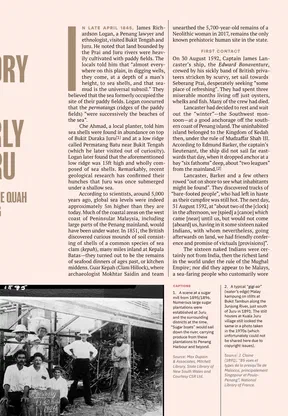
In 1592 the starving English privateer James Lancaster sailed towards the mainland and met ‘sixteen naked Indians’ in a canoe, who gave his crew food. The researcher Lim Teckwyn believes they were the Semang, an Orang Asli people of Juru. Lancaster survived and later led the East India Company’s first voyage.
The name ‘Juru’ probably meant ‘angle’ or ‘corner’, after the river’s sharp bends. Bugis settlers and, after 1821, Kedah Malays fleeing the Siamese invasion built villages here, and in the 1820s one of the first Malay schools on the mainland was set up. Industry later badly polluted the river. Today Kuala Juru villagers farm blood cockles and fish.
Key points
- A ridge near Bukit Tengah is made entirely of sea shells.
- The popular explanation that juru comes from 'juru tukang' (craftsman) is unconvincing.
- An 1820 map shows the area east of Bukit Juru was then called Bagan Nanas.
- Kampung Sekolah Juru and SK Juru may date from that early school.
- By 1976 the Juru River was among Malaysia's most polluted rivers.
Why it matters
Juru's deep history, from ancient shorelines to the Orang Asli, migration and industry, is usually overlooked, and the article gives an ordinary district its own story.
- Places
- Juru, Juru River, Bukit Tengah, Kuala Juru, Province Wellesley, Penang
- Subjects
- Juru, James Richardson Logan, James Lancaster, Semang, Guar Kepah