Penang Hill: A Natural Resource That Shaped the Settlement
Précis
This précis was automatically generated based on the full article text.
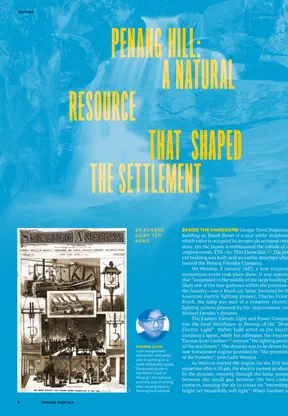
On 8 January 1883, a single electric arc lamp, as bright as 2,000 candles, lit up a foundry building at 37 Beach Street, the first electric light in Penang. Weeks later, Light Street became the first street in the Straits Settlements to have electric lighting. But the lamps were so harsh that people disliked them, and they were switched off after a few nights.
The company behind them planned to generate power from a waterfall at Air Itam, but money problems ended the scheme. The industrialist August Huttenbach succeeded where it failed. From 1894 his ice works at Batu Ferringhi ran on water power day and night, producing up to 30 tons of ice a day. It was the first working hydroelectric plant in the Straits Settlements.
In the 1890s, engineers also tried to build a railway up Penang Hill driven by a water wheel. On its first run the motors could not overcome friction, but the attempt showed that a hill railway was possible. The funicular finally opened in 1923–24.
Key points
- The first light used Charles Brush's arc-lamp system and was powered by a one-horsepower engine.
- The Maharaja (later Sultan) Abu Bakar of Johor attended the ball at the newly lit Town Hall.
- The Air Itam hydroelectric plant was sold off at a loss.
- Huttenbach's ice works stood where the Hard Rock Hotel is today.
- The 'waterfall that never failed' was on Tat's Stream, on land owned by Koh Seang Tat.
Why it matters
The article reframes Penang Hill as an engine of innovation, not only a cool retreat, and credits the experimenters whose failures prepared the way for later successes.
- Places
- Beach Street, Light Street, Air Itam, Batu Ferringhi, Penang Hill, Penang
- Subjects
- Eastern Electric Light and Power Company, Walter Judd, August Huttenbach, Tanjong Pinang Ice Works, Alan Wilson, Brush arc lamp