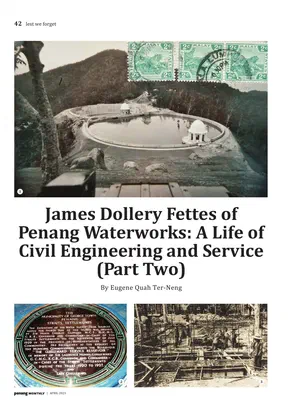
James Dollery Fettes of Penang Waterworks: A Life of Civil Engineering and Service (Part Two)
Précis
This précis was automatically generated based on the full article text.
Penang had excellent water, but not always enough. By the early 1900s officials were considering damming the waterfall valley, which would have drowned the Botanic Gardens. Fettes first built the Air Itam service reservoir, finished in 1915. He then went to the First World War, where he won the Military Cross for crossing the Canal du Nord under enemy challenge.
Back in Penang, he clashed with the promoters of the new Penang Hill Railway, because building and farming on the hill were polluting the streams that supplied the town. His answer, ‘Mr. Fettes’ Scheme’, was to take water from new catchments at Batu Ferringhi instead. Workers dug a 1.7 km tunnel through a ridge, working day and night, and piped the water across the Vale of Tempe to a new reservoir on Mount Erskine.
In 1929 Governor Sir Hugh Clifford opened the Guillemard Reservoir and publicly ’took his hat off’ to Fettes, who had not taken home leave in six years. Fettes died in Cardiff in 1931, aged 51. His colleagues blamed overwork.
Key points
- The 1915 Air Itam service reservoir is different from the much larger Air Itam Dam built in the 1960s.
- Fettes was demobilised as a Major and returned to Penang in 1919.
- The tunnel was dug at only 10–12 feet a day. It was lit by electricity and was 6 ft 6 in high.
- Water flows to the reservoir by gravity, with a drop of about 19 feet across the vale.
- The Municipality granted his widow $15,000 despite hard economic times.
Why it matters
Fettes' scheme still shapes Penang's water supply and saved the Botanic Gardens. The article restores credit to an engineer whose dedication cost him his life.
- Places
- Guillemard Reservoir, Air Itam, Batu Ferringhi, Vale of Tempe, Penang Botanic Gardens, Penang
- Subjects
- James Dollery Fettes, Guillemard Reservoir, Leonard Moore Bell, Hugh Clifford, Penang Hill Railway