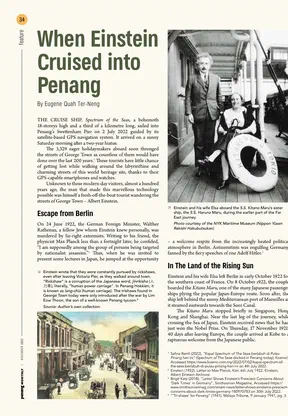
When Einstein Cruised into Penang
Précis
This précis was automatically generated based on the full article text.
In 1922, after a colleague was murdered by far-right extremists in Berlin, Albert Einstein was glad to accept an invitation to lecture in Japan. On the way there he learned he had won the Nobel Prize. On the voyage home his ship, the Haruna Maru, anchored off Penang at midday on 14 January 1923.
The ship was stiflingly hot. Einstein, his wife Elsa and some Japanese passengers climbed down a rope ladder into a small rowing boat and landed at Victoria Pier in the afternoon. Turning down the rickshaw pullers, they walked through George Town. He noted that the ‘boats, houses, people, all have style’.
They saw Chinese temples with ‘mysterious, terrifying, colourful’ decorations and the Kapitan Keling Mosque, whose slender minarets he admired. They hurried back before dark through choppy water, with Elsa frightened but ‘still with the strength to scold’, and sailed for Ceylon the next day.
Key points
- Einstein's diary entry begins: 'Mittags Ankunft in Penang', which means 'arrived in Penang at midday'.
- Victoria Pier, where they landed, was completed in 1888 and no longer exists.
- Rickshaw pullers shouted the names of the E&O and Runnymede hotels to touts for customers.
- The Kapitan Keling Mosque he saw was the 1910s design by Henry Alfred Neubronner.
- The article links Einstein's theory of relativity to the GPS that today's cruise passengers rely on.
Why it matters
It brings a world-famous scientist down to street level in George Town. Through his eyes, readers see what the city looked and felt like a century ago.
- Places
- George Town, Victoria Pier, Teluk Ayer Rajah, Penang
- Subjects
- Albert Einstein, Elsa Einstein, Haruna Maru, Kapitan Keling Mosque, Victoria Pier