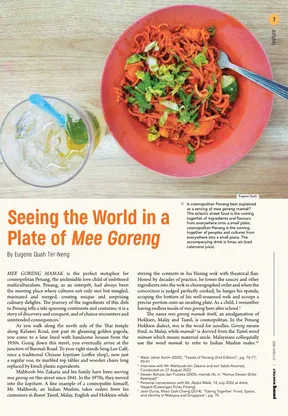
Seeing the World in a Plate of Mee Goreng
Précis
This précis was automatically generated based on the full article text.
Mee goreng mamak, spicy fried noodles cooked by Indian-Muslim hawkers, is for Eugene Quah the perfect symbol of Penang. Even the name mixes three languages: mee (noodles, Hokkien), goreng (fried, Malay) and mamak (from the Tamil word for ‘uncle’, used for Indian-Muslim men).
He traces each ingredient. The yellow wheat noodles and the pressed tofu (taukua) are Fujianese. Chillies and tomatoes came from the Americas through the Portuguese, and the chilli reached India by the 16th century. Kicap (sweet soy sauce) is an Indonesian word borrowed from the Hokkien for fish sauce, the same word that gave English ‘ketchup’.
At the centre of the story is Mahboob bin Zakaria, whose family has cooked mee goreng at Bangkok Lane since 1941. He takes orders in Tamil, Malay, English and Hokkien. The author remembers eating there after school, and sums up the dish as something that is ‘very, very improbable’ anywhere but Penang.
Key points
- Penang's role as a trading port made foreign ingredients such as wheat and soya beans cheap and easy to get.
- Yellow noodles contain no egg. Their colour comes from alkaline lye water.
- Chillies are native to the area around today's Peru and Bolivia and were used in the Americas 5,000–6,000 years ago.
- The dish brings together Chinese, Malay, Indian, Indonesian and American elements.
- The Bangkok Lane stall moved to the New World Park hawker centre in 2021.
Why it matters
The essay turns an everyday hawker dish into a lesson in global history. It shows how centuries of trade and migration made Penang's mixed culture feel natural to the people who live there.
- Places
- Bangkok Lane, Burmah Road, Pulau Tikus, Penang
- Subjects
- mee goreng mamak, Mahboob bin Zakaria, Seng Lee Café