Hong Seng Estate: The Urban Kampung by the Hill
Précis
This précis was automatically generated based on the full article text.
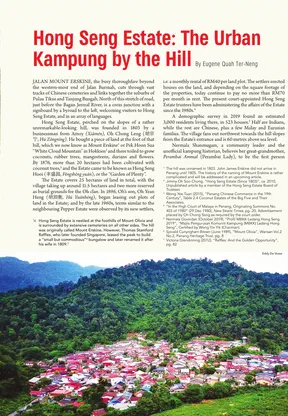
Off Jalan Mount Erskine, between cemeteries and busy suburbs, a signboard in several languages welcomes visitors to Hong Seng Estate. In 1803 Oh Chong Leng, a businessman from Amoy (Xiamen), bought land at the foot of a hill here and planted coconuts, fruit trees and flowers. It became known as the ‘Garden of Plenty’.
From 1896 his family leased out plots, and settlers built their own houses. Today about 3,000 people live in 523 houses and still pay very low monthly rents. About half are Indian and most of the rest Chinese. Local memory says the first settler was a Tamil woman, Perambai Ammal, whose family kept hundreds of cows. That is why some call it ‘Cowboy Village’.
Houses sit right beside, and sometimes around, the graves of the Oh clan, and residents treat them as neighbours. A Hindu temple, Chinese shrines and a Catholic chapel stand close together, and residents join in one another’s festivals.
Key points
- The estate was founded in 1803 and covers 25 hectares, including two Oh clan burial grounds.
- Rents are nominal: no more than RM70 a month.
- Cattle herding has continued here for more than a century.
- The Heng Lee soya sauce factory stands next to the old Oh ancestral hall.
- Fires, floods and landslides are real dangers in the closely packed village.
- Neighbouring Pepper Estate was sold to a developer in 2013, but Hong Seng's trustees and the state government say Hong Seng is not up for development.
Why it matters
Hong Seng Estate is one of the few places left where Penang's older, communal way of village life carries on inside the modern city. It also shows how fragile such places are under development pressure.
- Places
- Hong Seng Estate, Jalan Mount Erskine, Bagan Jermal, Penang
- Subjects
- Hong Seng Estate, Oh Chong Leng, Oh clan, Perambai Ammal