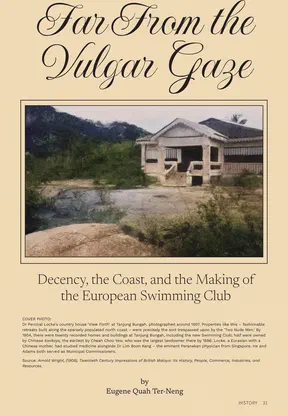
Far From the Vulgar Gaze: Decency, the Coast, and the Making of the European Swimming Club
Précis
This précis was automatically generated based on the full article text.
On a bright August evening in 1903, two European cyclists stopped at a Chinese gentleman’s beachfront house at Tanjung Bungah, stripped naked in view of his guests, swam, and refused to leave when asked. The owner complained to the Pinang Gazette as ‘Disgusted’. The men replied as ‘Two Nude Men’, claiming it was dusk and that they did not know ‘a Chinaman could be so easily offended’.
That was a mistake. ‘Disgusted’ and a second guest, ‘Decency’, dismantled their excuses, noting that the sun was still shining, and shamed them by the Empire’s own standards of decency. The editor soon closed the correspondence.
Penang’s Europeans had wanted a swimming club since 1892, when A.R. Adams won a municipal grant for a sea bath that Singapore then cancelled, partly because Chinese ratepayers’ money would have paid for a Europeans-only facility. In 1903 the College General agreed to rent beachfront land for $6 a month. Days after the scandal, the club was formed with 87 members. It opened in April 1904, with Adams joking that members could swim the ‘Hellespont’ to Pulau Tikus. For decades it admitted Europeans only. Today most of its members are Asian.
Key points
- By 1904, half of the 20 homes at Tanjung Bungah belonged to Chinese towkays.
- A European writer mocked the protest as 'Panchinomania', a coined insult.
- The earlier swimming options were a bath at the Waterfall Gardens, the costly Alexandra Hotel and The Spout.
- The Straits Independent called the Singapore government 'the apotheosis of humbug'.
- One day a week was set aside for women from the start.
Why it matters
A comic incident reveals the racial lines of colonial Penang, and how Chinese residents used the colonisers' own values to push back.
- Places
- Tanjung Bungah, Pulau Tikus, George Town, Penang
- Subjects
- Penang Swimming Club, 'Two Nude Men' affair, Arthur Robert Adams, College General, Percival Locke