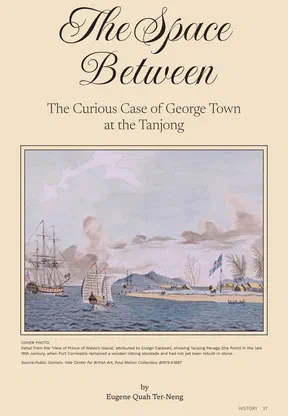
The Space Between: The Curious Case of George Town at the Tanjong
Précis
This précis was automatically generated based on the full article text.
After UNESCO listed George Town as a World Heritage Site in 2008, an old argument revived: is it ‘George Town’ or ‘Georgetown’? The author goes back to the records. Penang had been known to navigators for centuries, and when Francis Light took possession of it in 1786, he settled on a sandy cape called Tanjong Penaga. For years the settlement had no formal name. Early land grants and Captain Popham’s 1791 survey simply call it ’the town’ or ’the Point’, which in Malay is tanjung.
The earliest known use of ‘George Town’ is in Light’s will, written the day before he died in October 1794. His successor, Philip Mannington, used the name in 1795, while noting that people still called the place ’the Point’. ‘Tanjong’ survives today as the name of the local parliamentary seat.
The one-word ‘Georgetown’ first appeared in a sailors’ guidebook in 1801. Another editor corrected it three years later, but travellers such as Isabella Bird, who knew other Georgetowns, spread the mistake. Today it appears even on government letterheads and identity cards, though heritage bodies and UNESCO use ‘George Town’.
Key points
- Light did not 'find' Penang. The island appears on Zheng He's charts and in an Arab navigator's treatise of 1511.
- Historian Cheah Boon Kheng argues the occupation was effectively illegal until the 1791 treaty with Kedah.
- A 1794 mortgage record abbreviates the name as 'Geo. Town'.
- Light's will is held in the Penang State Museum.
- The author argues the space is a matter of historical accuracy, not colonial nostalgia.
Why it matters
It settles a long-running local debate with evidence, and shows how a single printing error can spread for two centuries.
- Places
- George Town, Tanjong Penaga, Fort Cornwallis, Penang
- Subjects
- George Town (name), Francis Light, Philip Mannington, Joseph Huddart, Isabella Bird