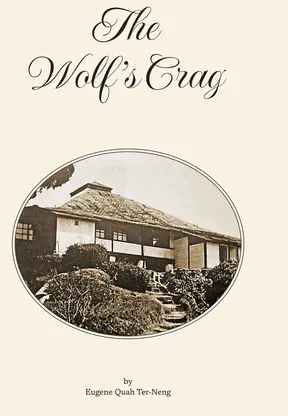
A Brief History of The Wolf's Crag
Précis
This précis was automatically generated based on the full article text.
The ridge where the Crag stands, with views over George Town, first belonged to William Clubley, an East India Company official who died in 1826. In 1845 a Mr. Bright built a sanatorium bungalow there, on what was briefly called Mount Ellenborough. By the 1860s it was known as ’the Crag’, short for ‘Wolf’s Crag’, a name probably taken from a castle in a Walter Scott novel.
Dutch tobacco planters owned it from 1885. In 1895 Captain John Kerr and his Penang Eurasian wife Alice turned it into a hotel. Guests were carried up in sedan chairs, and it became a favourite honeymoon spot. The Sarkies Brothers of the E&O Hotel modernised it in 1905, and the government bought it in 1920 to keep it public.
Government-run, it struggled. A big 1929 upgrade was followed at once by the Wall Street Crash. During the Japanese Occupation it was a rest resort for German submariners. The hotel closed in 1954 and became Uplands School, which Queen Elizabeth II visited in 1972. Since the school left in 1977 the Crag has stood empty, used only as a film set.
Key points
- Walter Scott was related to James Scott, Francis Light's business partner.
- The government paid $275,000 for the Crag in 1920.
- A planned new hotel at Bellevue was abandoned when the lowest tender came in at over $500,000.
- The Runnymede Hotel took over management in 1933.
- The Crag appeared in the film Indochine (1992) and the TV series Indian Summers (2014).
Why it matters
The Crag's story tracks Penang Hill's changing fortunes. Its empty buildings remain one of the hill's most evocative heritage sites.
- Places
- Penang Hill, The Crag, Bellevue, George Town, Penang
- Subjects
- The Crag Hotel, William Armstrong Clubley, John Kerr, Sarkies Brothers, Uplands School